
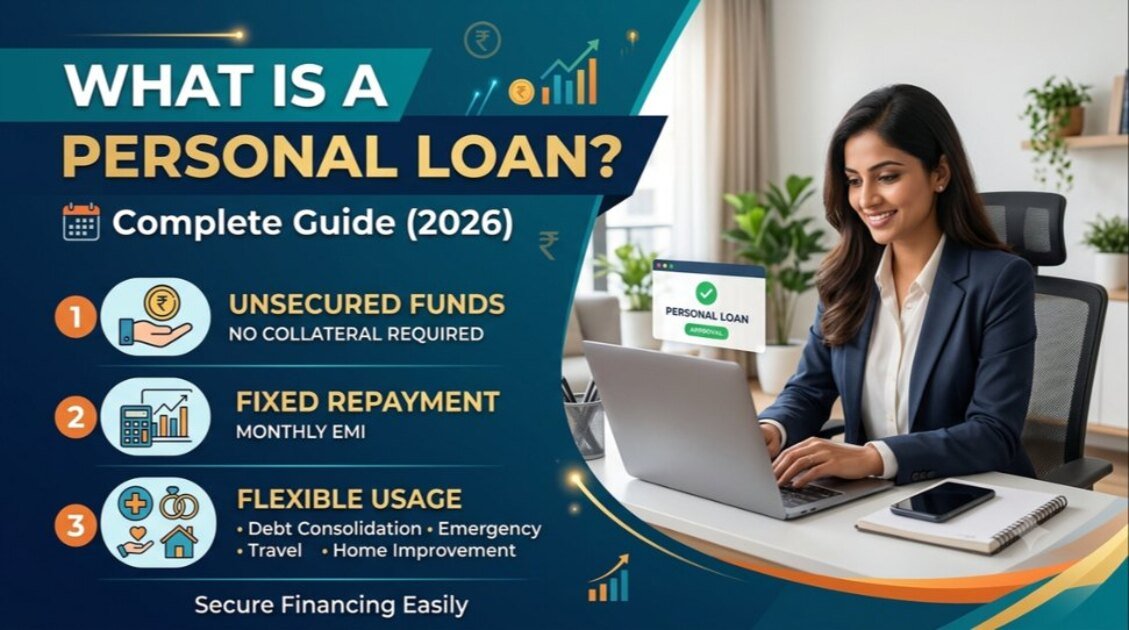
What Is a Personal Loan comprehensive guide banner with financial icons showing loan approval, low interest rates, and debt consolidation
Managing finances, paying down high-interest debt, or funding major life milestones can feel overwhelming in today’s economic climate. If you are exploring ways to streamline your debt or pay for a significant expense, you have likely come across one of the most popular financial tools available: what is a personal loan, and how can it work for your financial goals?
A personal loan is a versatile borrowing option that offers predictable monthly payments and structured terms. However, like any credit product, using one effectively requires a clear understanding of its mechanics, costs, eligibility criteria, and long-term impact on your credit profile.
This comprehensive guide breaks down everything you need to know about personal loans, how interest rates and fees are calculated, how they compare to other financial products, and how to shop for the best rate available.
What Is a Personal Loan and How Does It Work?
To understand the concept clearly: what is a personal loan? A personal loan is a form of installment credit offered by commercial banks, credit unions, and online direct lenders. Unlike a mortgage (which is strictly used to purchase real estate) or an auto loan (which is tied directly to a vehicle purchase), a personal loan yields a lump sum of cash that can be used for virtually any legal personal expense.
When you take out a personal loan, you borrow a specific amount of money upfront and agree to pay it back—plus interest and applicable administrative fees—over a set period.
The Core Mechanics of an Installment Loan
- Lump-Sum Payout: Upon loan approval and final verification, the lender transfers the entire loan amount directly into your bank account as a single payout.
- Fixed Repayment Schedule: You pay back the principal balance and interest through equal monthly payments over a set repayment term, typically ranging from 12 to 84 months (1 to 7 years).
- Structured Payoff Date: Unlike revolving credit accounts like credit cards, an installment loan has a clear end date. When you make your final scheduled payment, the balance reaches zero, and the loan account is closed in good standing.
Because most personal loans are unsecured—meaning they do not require physical collateral like your home or automobile—lenders evaluate your credit score, credit history, income stability, and overall debt load to determine your interest rate and borrowing limit.
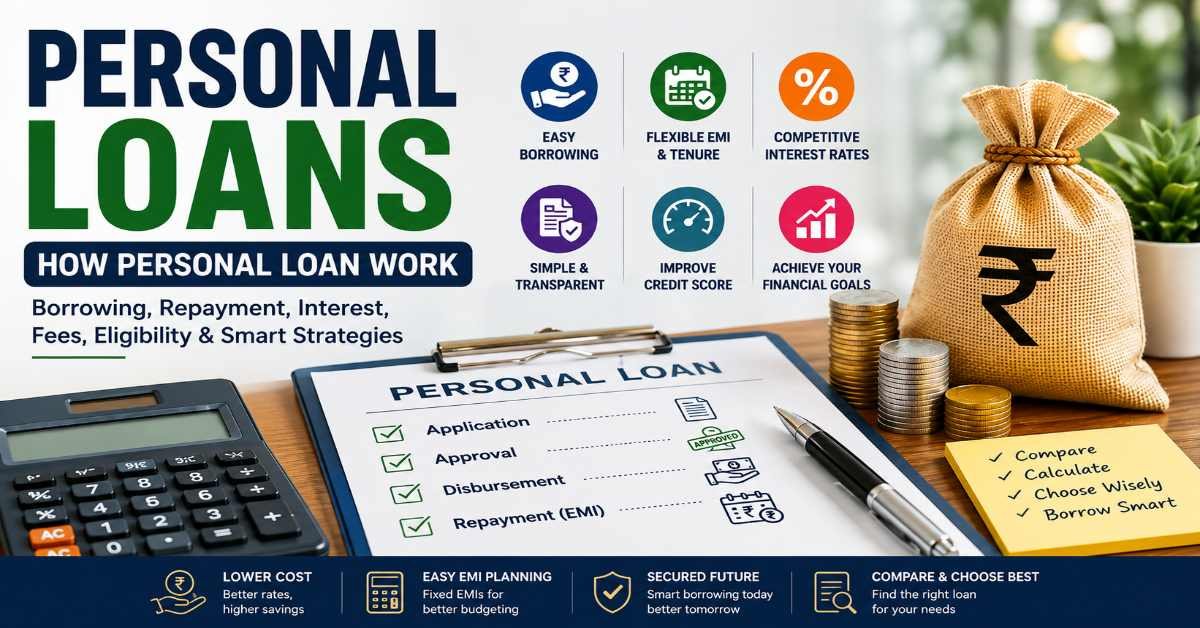
The Complete Lifecycle of a Personal Loan
Understanding how a personal loan moves from the initial idea to full payoff helps you plan your budget with confidence.
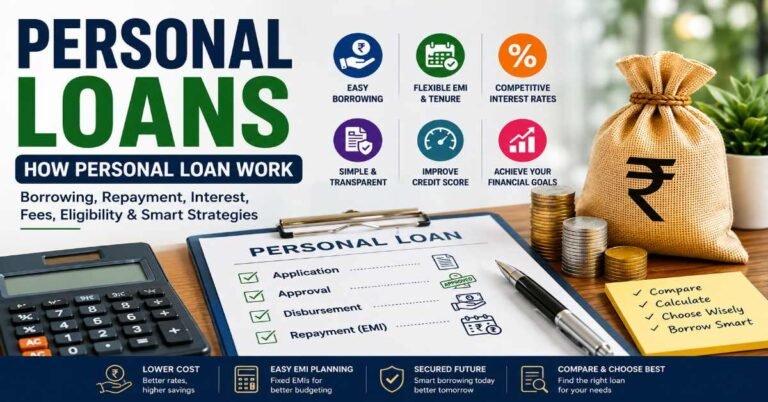
[ Step 1: Pre-Qualification ] ➔ [ Step 2: Formal Application ] ➔ [ Step 3: Funding & Disbursement ]
                                                                             │
[ Step 5: Loan Payoff & Closure ] ◄─── [ Step 4: Monthly Installments ] ◄────┘
Step 1: Pre-Qualification
During pre-qualification, you provide basic details such as your requested loan amount, estimated income, and contact information. Lenders run a soft credit check—which does not impact your credit score—to give you estimated loan offers, interest rates, and loan terms.
Step 2: Formal Application
Once you select a pre-qualification offer, you complete a formal application. At this stage, the lender performs a hard credit inquiry and asks for supporting financial documentation (such as pay stubs, W-2 forms, tax returns, and government-issued identification).
Step 3: Funding & Disbursement
After the lender verifies your documentation and grants final approval, the loan agreement is generated. Once you sign the agreement, the funds are deposited directly into your checking account (or sent directly to your existing creditors if you are consolidating debt).
Step 4: Monthly Repayment
Your repayment schedule begins approximately 30 days after disbursement. Each monthly payment is split between reducing your principal balance and paying monthly interest charges, structured according to an amortization schedule.

Step 5: Loan Payoff & Closure
Once you complete all payments according to your schedule (or pay off the remaining balance early), your loan account is closed, and the lender reports the fully satisfied debt to the major credit bureaus.
Essential Terms to Understand Before Borrowing
When answering what is a personal loan, it is equally critical to understand the financial vocabulary used in loan contracts:
- Principal: The actual sum of money you borrow, excluding interest, fees, and finance charges.
- Interest Rate: The percentage cost charged by the lender to borrow the principal balance, calculated annually.
- Annual Percentage Rate (APR): The total yearly cost of borrowing money. APR includes both the nominal interest rate and mandatory fees (such as origination fees). APR provides a standardized metric to compare different lenders.
- Loan Term: The total duration over which you agree to pay back the loan (e.g., 36, 48, or 60 months).
- Amortization: A repayment structure where each monthly payment is divided into interest and principal reduction, with interest making up a larger portion of early payments and principal making up a larger portion later in the term.
- Collateral: A valuable physical asset (such as real estate, vehicles, or savings accounts) pledged to a lender to secure a loan.
- Origination Fee: An upfront processing fee charged by lenders to cover administrative costs, typically ranging from 1% to 10% of the loan amount.
The Primary Types of Personal Loans
Personal loans are customized to suit different financial situations. Lenders offer several distinct structures:

1. Unsecured Personal Loans
This is the most widespread type of personal loan.
- Collateral Required: None.
- Risk Factor: The lender assumes more risk, meaning qualification depends heavily on your credit score and financial stability.
- Best For: Borrowers with good-to-excellent credit profiles looking for straightforward cash options.
2. Secured Personal Loans
A secured loan requires you to back the debt with a personal asset, such as a certificate of deposit (CD), savings balance, or vehicle title.
- Collateral Required: Yes (savings, vehicle, property).
- Risk Factor: Lower risk for the lender. If you default on your monthly payments, the lender has the legal authority to seize the collateral to recover their losses.
- Best For: Borrowers with fair or limited credit who need lower interest rates or higher approval odds.
3. Fixed-Rate vs. Variable-Rate Personal Loans
| Metric | Fixed-Rate Personal Loans | Variable-Rate Personal Loans |
| Interest Rate Behavior | Remains constant across the entire loan term | Fluctuates periodically based on benchmark market rates |
| Monthly Payment Amount | Predictable and unchanged every month | Can increase or decrease based on rate shifts |
| Budgeting Advantage | Excellent for long-term planning | Potentially advantageous if benchmark rates decline |
| Risk Exposure | Protected against market rate hikes | Vulnerable to sudden interest rate spikes |
4. Specialized Personal Loans
- Debt Consolidation Loans: Designed to pay off multiple credit balances, often offering direct disbursement to your existing third-party creditors.
- Joint and Co-signed Loans: Allow an applicant with fair credit to add a creditworthy co-borrower or co-signer to qualify for lower interest rates and larger loan amounts.
Strategic Uses for Personal Loans
Because personal loans offer lump-sum payouts, fixed interest rates, and predictable repayment schedules, they can serve as an effective tool when managed responsibly.
                          ┌── Debt Consolidation (High Credit Card APRs ➔ Lower Fixed Rate)
                          ├── Home Improvement & Critical Repairs (Roof, HVAC, Renovations)
SMART USAGE STRATEGIES ───┼── Major Unforeseen Emergencies (Medical Expenses, Urgent Bills)
                          └── Refinancing Existing High-Interest Loans
1. High-Interest Debt Consolidation
One of the most practical applications of a personal loan is rolling high-interest credit card debt into a single lower-cost loan. Credit card accounts often charge revolving interest rates between 20% and 30% APR. Replacing multiple card payments with a single fixed-rate personal loan can reduce interest costs and streamline budgeting.
Debt Consolidation Financial Comparison:
- Current Credit Card Balances: $18,000 across 3 cards at an average 24% APR.
- Minimum Monthly Payment Strategy: Takes over 9 years to eliminate, accumulating roughly $14,500 in total interest charges.
- Personal Loan Alternative: $18,000 personal loan at an 11% APR over a 48-month term.
- Fixed Monthly Payment: Approximately $465 per month.
- Total Time to Pay Off: Exactly 4 years.
- Total Interest Cost: Approximately $4,330.
- Net Savings:Over $10,000 saved in total interest payments alone.
2. Home Improvement and Property Preservation
Using a personal loan to fund structural repairs, replace an aging roof, install energy-efficient solar updates, or renovate a kitchen can boost your home’s resale value and equity. Unlike a home equity line of credit (HELOC) or a second mortgage, an unsecured personal loan does not put your primary residence at risk as collateral.
3. Handling Unplanned Emergency Expenses
When unexpected events strike—such as urgent medical procedures, emergency pet care, or major car breakdowns—and exceed your emergency fund, a personal loan offers a structured alternative to carrying balances on high-interest credit cards.
When You Should Avoid Taking Out a Personal Loan
While personal loans are flexible, borrowing money incurs cost. You should generally avoid taking out personal loans for:
- Discretionary Luxury Purchases: Financing vacations, high-end clothing, lavish weddings, or luxury electronics introduces long-term interest burdens to short-term experiences.
- Speculative Investments: Taking out a loan to trade individual stocks, cryptocurrency, or speculative business ventures exposes you to compounding financial risk.
- Higher Education Expenses: Federal student loans offer superior borrower protections, including income-driven repayment plans, loan forgiveness options, and deferment programs that personal loans do not provide.
- Covering Routine Daily Expenses: Relying on personal loans to pay for basic necessities like rent, utilities, or groceries usually points to a underlying budget shortfall that borrowing cannot fix long-term.
Personal Loans vs. Alternative Financial Products
Before submitting an application, compare personal loans against other common credit options:
1. Personal Loans vs. Credit Cards
| Metric | Personal Loan | Credit Card |
| Credit Structure | Installment Credit | Revolving Credit Line |
| Funding Structure | Single upfront lump-sum payout | Ongoing access to credit up to a designated limit |
| Interest Rates | Generally lower fixed rates (6% to 36% APR) | Generally higher variable rates (18% to 30%+ APR) |
| Repayment Period | Set timeline (e.g., 3 to 7 years) | Indefinite; dependent on minimum monthly payments |
| Best Used For | One-time large purchases & debt consolidation | Day-to-day shopping & flexible, short-term needs |
2. Personal Loans vs. Home Equity Lines of Credit (HELOCs)
- HELOC: Uses your home equity as collateral. Offers lower interest rates and flexible drawdown limits, but puts your real estate at risk if you encounter financial hardship.
- Personal Loan: Generally unsecured. Requires no home appraisal, provides faster funding (often within 24 to 48 hours), and leaves your property completely unencumbered.
The Real Cost of Borrowing: Interest, APR, and Hidden Fees
Calculating the true cost of borrowing requires looking past headline interest rates to evaluate the full fee structure disclosed in loan terms.
Key Fees to Account For:
- Origination Fees (1% to 10%): Deducted directly from your initial loan proceeds. For example, if you borrow $10,000 with a 5% origination fee, you receive $9,500 in your bank account, but your starting loan balance remains $10,000.
- Prepayment Penalties: Fees charged by certain traditional lenders if you clear your loan balance ahead of schedule. (Tip: Look for lenders that charge zero prepayment penalties).
- Late Payment Fees: Assessment fees charged if your installment payment arrives after the standard grace period (typically 10 to 15 days).
- Insufficient Funds Fees: Applied if an automatic transfer fails due to an inadequate bank account balance.
Step-by-Step Guide to Getting Approved for a Personal Loan
Following a systematic approach helps you locate competitive interest rates and favorable repayment terms.
[ 1. Check Credit Score ] ➔ [ 2. Calculate DTI ] ➔ [ 3. Prequalify & Compare ]
                                                                 │
[ 6. Final Funding ] ◄───── [ 5. Submit Docs ] ◄─── [ 4. Select Offer ]
Step 1: Check Your Credit Profile
Obtain your credit report to check for accuracy and review your credit score. Lenders generally categorize scores as follows:
- 740+ (Excellent): Qualifies for the lowest interest rates, lowest fees, and highest limits.
- 670 – 739 (Good): Qualifies easily with competitive terms.
- 580 – 669 (Fair): Qualifies with moderate rates; may encounter origination fees or require collateral.
- Below 580 (Poor): May require a creditworthy co-signer or a secured loan structure.
Step 2: Calculate Your Debt-to-Income (DTI) Ratio
Lenders evaluate your monthly debt payments against your gross monthly income to measure your repayment capacity:
$$\text{DTI Ratio} = \left( \frac{\text{Total Monthly Debt Obligations}}{\text{Gross Monthly Income}} \right) \times 100$$
Most competitive lenders prefer a DTI ratio below 36%, though some lenders accept ratios up to 45% or 50%.
Step 3: Prequalify with Multiple Lenders
Submit pre-qualification requests across 3 to 5 online platforms, banks, and local credit unions. Soft credit checks allow you to compare estimated APRs without affecting your credit score.
Step 4: Compare Loan Offers Side-by-Side
Evaluate:
- The APR (interest plus mandatory fees)
- Monthly payment amount relative to your cash flow
- Total repayment cost over the life of the loan
- Flexibility options (such as hardship pause programs or fee-free early payoffs)
Step 5: Gather Documentation and Apply
Select the best offer and submit a formal application. Gather key documents beforehand:
- Government-Issued ID: Driver’s license, passport, or state ID.
- Proof of Income: Pay stubs, W-2 forms, 1099 statements, or tax returns.
- Proof of Address: Recent utility bills, lease agreements, or bank statements.
How a Personal Loan Affects Your Credit Score
Taking out a personal loan influences your credit profile across two distinct stages:
Short-Term Impacts (Temporary Dip)
- Hard Credit Inquiry: Submitting a formal application triggers a hard check, which typically lowers your credit score by a few points temporarily.
- New Account Addition: Opening a new loan account lowers the overall average age of your credit accounts.
Long-Term Benefits (Potential Score Increase)
- Improved Credit Mix: Adding an installment loan to a profile composed mainly of revolving credit cards diversifies your credit mix (which accounts for 10% of your FICO score).
- Reduced Credit Utilization: Using a personal loan to pay off credit card balances lowers your revolving credit utilization ratio—a primary driver of credit scoring models.
- Consistent Payment History: Making on-time monthly payments builds a solid payment record, which accounts for 35% of your total credit score.
Frequently Asked Questions (FAQ)
Q1: Can I pay off my personal loan early?
Yes, most online lenders and credit unions allow you to pay off your balance early without charging prepayment penalties. Paying off a loan early reduces the overall interest you pay across the term.
Q2: How quickly are personal loan funds disbursed?
Funding times vary by financial institution. Many modern online lenders process and disburse funds within 24 to 48 hours via direct deposit upon final document verification.
Q3: Can I qualify for a personal loan with bad credit?
Yes, options exist for poor credit profiles. However, these loans usually come with higher APRs and origination fees. Adding a creditworthy co-signer or opting for a secured loan can improve your approval odds and unlock lower rates.
Q4: Is personal loan interest tax-deductible?
In most scenarios, no. Interest paid on personal loans used for consumer purchases, vacations, or general debt consolidation is not tax-deductible. The exception occurs when loan proceeds are strictly used for verifiable business operations or qualifying primary home improvements (always consult a certified tax professional for guidance).
Final Thoughts: Is a Personal Loan the Right Fit?
When asking what is a personal loan, the takeaway is that it is a versatile financial instrument designed to provide lump-sum capital with predictable, structured terms. When used strategically—such as replacing high-interest credit card debt with a lower fixed rate—it can help accelerate your progress toward debt reduction and financial control.
Before committing to a loan contract, run your numbers carefully, compare APRs across multiple lenders, and ensure that your monthly installment fits comfortably into your budget over the long haul.



1 thought on “What Is a Personal Loan? The Smart Way to Borrow in 2026”
Comments are closed.