
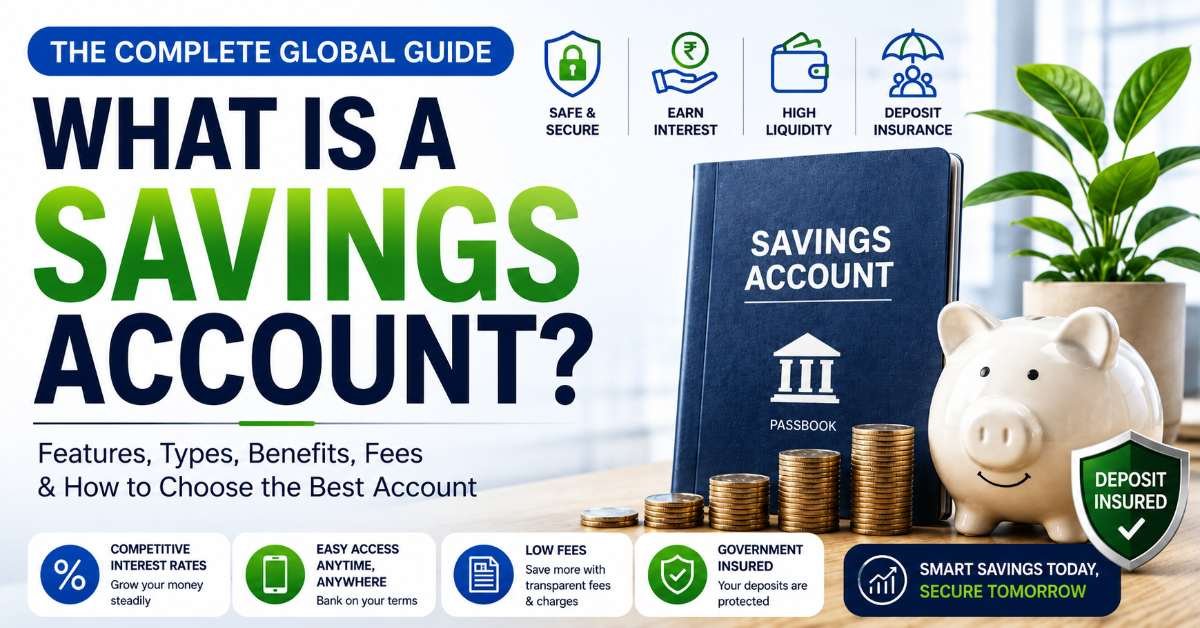
Managing personal finances effectively begins with choosing the right foundation for your cash. Whether you are building an emergency fund, planning a vacation, or setting aside capital for unexpected life events, choosing a safe place to hold your money is crucial.
At its core, understanding what is a savings account helps you optimize cash flow, protect liquid assets, and earn steady returns without taking on unnecessary risk. This comprehensive guide covers everything you need to know about savings accounts, how they operate globally, their variations, fees, interest calculation methods, and strategies to maximize your returns.
Defining a Savings Account
A savings account is an interest-bearing deposit account maintained at a retail bank, digital bank, building society, or credit union. Unlike standard transaction accounts meant for everyday utility bills and retail purchases, a savings account is engineered to preserve capital over the short to medium term while generating modest interest income.

When you deposit funds into a savings account, you lend that capital to the financial institution. In exchange for holding your deposits—which institutions use to issue loans to other consumers or businesses—the bank pays you a return known as interest. For an overview of how financial institutions are regulated, you can explore resources from the Bank for International Settlements (BIS).
Primary Characteristics
- Capital Preservation: Your principal balance does not fluctuate with stock or bond market volatility.
- Liquidity: You retain convenient access to your cash compared to long-term investment vehicles or locked term deposits.
- Yield Generation: Your money compounds over time through regular interest payouts.
- Statutory Deposit Insurance: In most established financial jurisdictions, balances up to a statutory limit are backed by government-sponsored insurance programs.
How Personal Loans Work: Interest, EMI, Fees & Repayment Guide
How Does a Savings Account Work?
Operating a savings account involves a balance between accessibility and growth. When funds are deposited into your account:
- Balance Tracking: The bank records your daily ledger balance.
- Interest Accrual: Interest is calculated based on an agreed annual rate, often computed on daily end-of-day balances.
- Compounding Cycles: The accrued interest is credited to the principal balance at set intervals—typically monthly, quarterly, or semi-annually.
- Subsequent Compounding: Future interest calculations apply to the combined total of the original deposits and previously credited interest earnings, creating compound growth.
Understanding Interest Rates: APY vs. APR
When evaluating accounts, two standard financial metrics appear:
- Annual Percentage Rate (APR): Reflects the simple interest rate over a year without considering the impact of compounding.
- Annual Percentage Yield (APY) / Effective Annual Rate (EAR): Measures the total amount of interest you earn over one full year, taking into account the frequency of compounding (daily, monthly, or quarterly). You can learn more about consumer protections related to rate disclosures at the Consumer Financial Protection Bureau (CFPB).
Because compounding generates interest on top of past interest, the APY is always slightly higher than the nominal base interest rate when compounding occurs more frequently than once per year.
How to Create a Budget: 10 Simple Steps to Take Control of Your Money
Key Types of Savings Accounts Worldwide
Financial institutions across different countries structure their savings products to serve varying consumer needs. Understanding these variations helps you pick the right vehicle for your specific goals.
1. Traditional Savings Accounts
Offered by conventional brick-and-mortar retail banks, these accounts provide direct access to physical branch networks, in-person customer service, and integrated automated teller machine (ATM) access. They generally maintain lower minimum opening deposits, though they typically offer lower interest rates due to the operational costs of maintaining physical branches.
2. High-Yield Savings Accounts (HYSAs)
Primarily offered by online-only financial institutions and neo-banks, HYSAs provide significantly higher interest yields than traditional accounts. Because digital banks operate without the overhead of physical real estate, they pass operational savings directly to account holders in the form of elevated interest rates.
3. Money Market Accounts (MMAs)
A hybrid product bridging checking and savings, money market accounts often offer tiered interest rates alongside direct check-writing capabilities and debit card access. They frequently require higher minimum balances to avoid maintenance charges or unlock the highest interest tiers.
4. Certificates of Deposit (CDs) / Fixed & Term Deposits
These instruments require you to lock away a set sum of cash for a specified period—ranging from one month to several years. In exchange for sacrificing immediate liquidity, the bank guarantees a fixed, higher interest rate throughout the entire term. Early withdrawals typically incur interest penalties.
5. Cash Management Accounts (CMAs)
Offered primarily by non-bank financial institutions, online brokerages, and robo-advisors, CMAs combine features of savings and checking accounts. They sweep customer cash balances across partner banks to maximize yield and expand regulatory insurance coverage limits.
6. Specialized & Tax-Advantaged Accounts
Governments worldwide provide targeted savings vehicles designed around specific life stages:
- Youth and Minor Accounts: Structured to help minors learn basic money management under parental supervision.
- Retirement Accumulation Accounts: Specialized accounts that offer tax exemptions or deferrals to encourage retirement planning.
- Healthcare Accounts: Dedicated products designed to hold pretax cash exclusively for verified medical costs.
What Is Investing? A Complete Guide to Building Wealth in 2026
Global Deposit Insurance and Fund Protection
A major advantage of regulated savings accounts is protection against institutional insolvency. Most countries maintain statutory deposit insurance funds to protect consumer deposits up to defined legal ceilings.
Global Safety Nets Overview
- United States: Backed by the Federal Deposit Insurance Corporation (FDIC) for banks or the National Credit Union Administration (NCUA) for credit unions, insuring up to $250,000 per depositor, per insured bank, for each account ownership category.
- United Kingdom: Protected by the Financial Services Compensation Scheme (FSCS), covering eligible deposits up to £85,000 per person, per authorized banking group.
- European Union: Governed by national Deposit Guarantee Schemes aligned under the European Banking Authority (EBA), protecting deposits up to €100,000 per depositor, per institution.
- Canada: Regulated by the Canada Deposit Insurance Corporation (CDIC), covering eligible deposits up to $100,000 CAD per insured category.
- Australia: Covered by the Australian Government Guarantee administered via the Australian Prudential Regulation Authority (APRA), protecting eligible deposits up to $250,000 AUD per account holder, per authorized deposit-taking institution (ADI).
- India: Protected by the Deposit Insurance and Credit Guarantee Corporation (DICGC), a subsidiary of the Reserve Bank of India, covering principal and interest up to ₹500,000 per depositor across accounts in the same bank.
Always ensure any financial institution you use is fully licensed and recognized by the relevant statutory regulatory body in its operating jurisdiction.
What Is Cryptocurrency 2026? How Crypto, Bitcoin & Blockchain Work
Comparing Savings Accounts to Other Financial Instruments
Selecting the right vehicle depends on your liquidity requirements, risk tolerance, and time horizon.
Savings Accounts vs. Checking / Current Accounts
- Purpose: Checking accounts are transactional tools built for frequent daily inflows and outflows, utility debits, and point-of-sale payments. Savings accounts are designed to keep money aside for future needs.
- Yield: Checking accounts usually pay zero or negligible interest. Savings accounts are explicitly structured to pay compound interest.
- Access Restraints: Checking accounts offer unlimited debit card transactions and check facilities, whereas savings accounts encourage fewer regular withdrawals.
Savings Accounts vs. Investment Portfolios
- Volatility: Equities, exchange-traded funds (ETFs), and mutual funds fluctuate with broader economic conditions, carrying the risk of capital loss. Savings accounts maintain a steady, guaranteed balance backed by deposit insurance.
- Return Potential: Over long timeframes, equity portfolios historically outpace inflation by wider margins than savings accounts. For market and investing fundamentals, the U.S. Securities and Exchange Commission Investor Education Portal provides clear guidance on managing market risks.
Common Fees and Account Conditions
While savings accounts are generally low-cost financial products, certain operational fees can erode your balance if unmanaged:
- Monthly Maintenance Fees: Charges imposed by banks to maintain the account ledger. These can often be waived by maintaining a qualifying minimum balance or setting up recurring monthly direct deposits.
- Excess Withdrawal Fees: Charges levied when an account holder exceeds the allowable number of monthly outgoing transfers or withdrawals.
- Inactivity / Dormancy Fees: Costs applied when an account shows no customer-initiated transactions over an extended timeframe (such as 12 to 24 consecutive months).
- Paper Statement Fees: Minor monthly fees for receiving printed physical statements via postal mail rather than digital e-statements.
- Out-of-Network ATM Charges: Fees applied when withdrawing physical currency using third-party automated teller networks.
- Wire and International Transfer Fees: Administrative costs associated with sending or receiving wire transfers or international remittances.
How to Buy a House in 2026: Complete Step-by-Step Guide for First-Time Buyers
How to Choose the Best Savings Account
Selecting the right savings account depends on your personal financial goals and banking habits. Use this checklist to evaluate prospective providers:
- Competitive Interest Yields: Look for institutions offering consistent, competitive APYs rather than temporary introductory teaser rates.
- Fee Structures and Waiver Rules: Verify whether the account charges monthly maintenance fees and whether the waiver criteria align with your normal cash habits.
- Minimum Deposit and Balance Mandates: Check the initial opening balance requirements and ongoing minimum balance thresholds.
- Digital Banking Experience: Ensure the bank offers a reliable mobile application, intuitive online portals, clear statements, and robust security features like multi-factor authentication (MFA).
- Customer Support Availability: Confirm that the provider offers accessible customer service through live chat, phone, or local branches.
- Regulatory Compliance: Verify that the institution holds an active banking license and is covered by the appropriate national deposit insurance program.
Step-by-Step Guide: Opening a Savings Account
Opening an account is straightforward, whether completed online or at a physical branch:
Step 1: Gather Required Documentation
Regulated banking laws worldwide follow Know Your Customer (KYC) standards guided by global bodies like the Financial Action Task Force (FATF). You will typically need:
- A valid government-issued photo identification (such as a passport, national ID card, or driver’s license).
- Proof of physical residence (such as a recent utility bill, municipal tax invoice, or rental contract).
- A national tax identification number (such as a Social Security Number, National Insurance Number, PAN, or local equivalent).
- Contact credentials (active personal email address and primary telephone number).
Step 2: Submit the Application
Complete the personal details form via the provider’s official online portal or at a local branch office. Ensure all legal names match your identity documents exactly.
Step 3: Fund the Account
Transfer your initial deposit to meet any minimum funding requirement. Common funding methods include:
- Electronic funds transfers (EFT/ACH) from an existing linked bank account.
- Debit card instant transfers.
- In-branch cash or check deposits.
- Direct deposit allocation through an employer payroll system.
Step 4: Configure Account Settings and Security
Once verified and funded:
- Activate multi-factor authentication (MFA).
- Opt in to paperless electronic statements.
- Set up automated recurring transfers from your main checking account to build your savings systematically.
- Configure custom balance alerts and withdrawal notifications.
Strategies to Maximize Your Savings Account
To get the most out of your savings account, consider using these practical financial strategies:
1. Build an Emergency Fund
A solid emergency fund covers 3 to 6 months of essential living expenses (housing, utilities, food, insurance, debt payments). Keeping this safety net in an accessible, liquid high-yield savings account protects you against unexpected expenses without forcing you to sell investments or rely on high-interest credit cards.
2. Automate Your Contributions
Relying on manual transfers at the end of each month often leaves little cash behind to save. Set up an automated recurring transfer on your payday to move a fixed percentage of your income directly into your savings account. This “pay yourself first” approach ensures consistent balance growth.
3. Use Account Sub-Buckets for Specific Goals
Many digital banks allow you to partition a single savings account into targeted sub-accounts or “goal buckets.” Segmenting your balance for specific targets—such as an annual insurance premium, holiday travel, or home down payment—makes it easier to monitor progress toward individual financial milestones.
4. Review Your Interest Rates Periodically
Central bank monetary policies and market conditions shift regularly. An interest rate that was competitive a year ago may lag the broader market today. Review your account’s APY every six months to confirm your bank remains competitive, and be willing to move funds to higher-yielding institutions when appropriate.
5. Keep Everyday Spending Separate
Keeping your daily spending money and emergency reserves in the same checking account increases the temptation to spend your savings. Maintaining a dedicated savings account creates a helpful psychological and practical barrier between daily spending cash and long-term funds.
What Is Copyright 2026? Complete Guide to Copyright Protection & Online Rights
Frequently Asked Questions (FAQ)
Can you lose money in a savings account?
In an officially licensed and regulated banking institution, your nominal balance is protected against bank default up to the national deposit insurance limits. However, if the interest rate earned on your balance is lower than the prevailing annual inflation rate, the real purchasing power of your money can decline over extended periods.
How many savings accounts should an individual hold?
There is no single rule for how many accounts you should have. Many individuals successfully operate with two or three savings accounts dedicated to distinct financial purposes (e.g., an emergency fund, short-term project reserves, and long-term cash goals).
Is interest earned from a savings account subject to taxation?
In most jurisdictions, interest earned on savings deposits is categorized as taxable income. Depending on local tax regulations, institutions may automatically withhold tax at the source or provide an annual interest tax certificate for you to declare on your yearly tax return.
What is the primary difference between a savings account and a high-yield savings account?
The main difference is the interest rate. High-yield savings accounts typically offer annual yields significantly higher than standard savings accounts. They are most commonly offered by online-only financial institutions that pass operational savings directly to customers.
A savings account remains one of the simplest, safest, and most dependable tools for managing liquid cash. By choosing an institution that offers competitive yields, low fees, and strong regulatory protection, you can safeguard your financial reserves while putting your money to work.








1 thought on “What Is a Savings Account? Types, Benefits, Interest & Fees”
Comments are closed.