
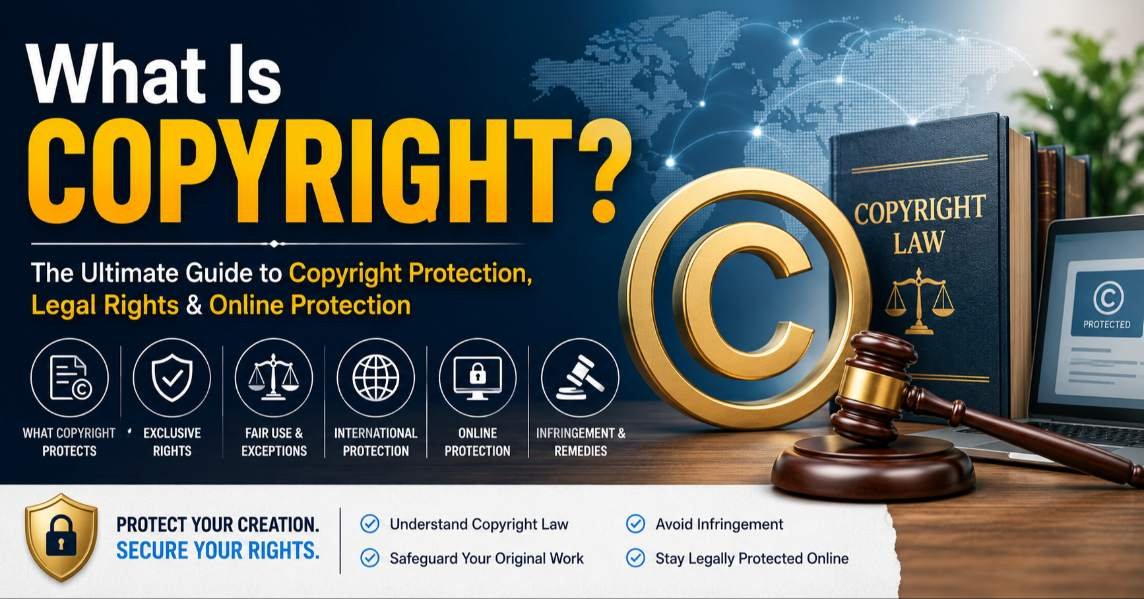
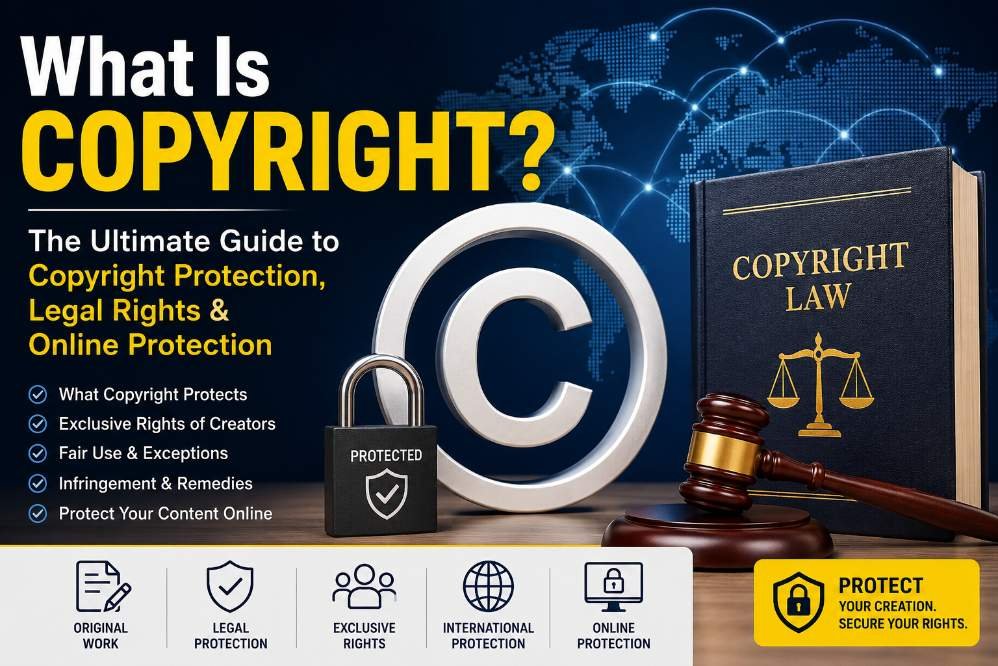
In a world where digital content is created, shared, and reproduced every fraction of a second, understanding who owns what—and how that ownership is protected—is essential. Whether you are a blogger, software developer, musician, artist, entrepreneur, or student, copyright law forms the foundational framework that safeguards your intellectual work from unauthorized exploitation.
This complete guide breaks down everything you need to know about copyright: what it means, how it functions globally, what it protects, key exemptions like Fair Use, and actionable steps to protect your work online.
What Is a Trademark? Complete Guide to Brand Protection
Defining Copyright: What Is Copyright?
Copyright is a legal concept and form of intellectual property protection that grants creators exclusive legal rights over the use, distribution, adaptation, display, and performance of their original tangible works.
When an individual produces an original creative work—such as writing an essay, composing a melody, painting a portrait, or programming a software application—copyright law guarantees that they hold sole authority over how that creation is commercialized, reproduced, and shared with the public. To learn more about standard intellectual property definitions globally, you can consult the official guide from the World Intellectual Property Organization (WIPO).
Process of Protection: Original Idea ➔ Fixed in Tangible Form ➔ Automatic Copyright Protection
A crucial legal distinction to keep in mind is that copyright does not protect raw ideas, facts, or concepts. Instead, it protects the expression of those ideas once they are fixed in a tangible or stable medium (e.g., written down, recorded, coded, or saved to a storage drive).
What Is Health Insurance? Types, Coverage, Costs & Benefits Explained
The Core Purpose of Copyright Law
At its fundamental level, copyright law strikes a deliberate balance between two competing societal goals:
- Incentivizing Innovation and Creativity: By granting creators exclusive financial and moral rights, lawmakers ensure that artists, writers, and inventors can profit from their labor. Without economic incentives, fewer people would dedicate their lives to creative endeavors.
- Promoting Public Knowledge and Progress: Copyright protection is strictly limited in duration. Eventually, all copyrighted works transition into the Public Domain, allowing society at large to freely build upon, adapt, and learn from past creative achievements.
The History and Evolution of Copyright
Understanding where copyright originated helps clarify how modern digital copyright systems function today.
Key Milestones in Copyright History:
- 1710 – The Statute of Anne (1710): Enacted in Great Britain, the Statute of Anne is recognized as the world’s first formal legal copyright framework. It shifted copyright ownership from printers/publishers directly to authors, establishing a fixed 14-year term of protection.
- 1790 – The U.S. Copyright Act of 1790: Enacted under the newly formed United States Constitution, this act granted American authors and creators exclusive rights to maps, charts, and books for 14 years, renewable for another 14.
- 1886 – The Berne Convention: An international treaty established in Berne, Switzerland, designed to harmonize copyright recognition across national borders. It eliminated formal registration requirements for international protection.
- 1998 – Digital Millennium Copyright Act (DMCA): Enacted by the United States Congress, the DMCA adapted traditional copyright law to address the internet age, establishing notice-and-takedown procedures for online service providers.
What Can and Cannot Be Copyrighted?
Not every creative output qualifies for protection under copyright law. To qualify, a work must meet three fundamental criteria:
- Originality: The work must be independently created by the author and exhibit at least a minimal degree of creative expression.
- Creativity: Standard alphabetizing, basic operational procedures, or lists of ingredients lack sufficient creative expression.
- Fixation: The work must be recorded in a physical or digital format (paper, audio file, hard drive, video tape, canvas).
What Is Life Insurance ? Complete Guide to Coverage, Types & Benefits
Protected Works (Eligible for Copyright)
- Written & Technical: Books, articles, blog posts, academic papers, software source code, website copy.
- Visual Arts: Paintings, illustrations, graphic designs, architectural blueprints, photographs.
- Audio & Media: Songs, musical arrangements, recorded podcasts, audiobooks, voice tracks.
- Video & Motion: Movies, documentaries, YouTube videos, animated clips, video games.
Unprotected Elements (Ineligible for Copyright)
- Written & Technical: Ideas, concepts, operational procedures, mathematical algorithms, generic lists.
- Visual Arts: Basic geometric shapes, color combinations, common symbols, generic typography.
- Audio & Media: Individual musical chords, spoken unscripted conversation, standard sound tones.
- Video & Motion: Plot tropes (e.g., “hero’s journey”), generic themes, historical facts depicted in film.
How Does Copyright Protection Work?
One of the most common misconceptions about copyright is that you must register your work or hire an attorney to receive legal protection.
1. Automatic Acquisition
In almost all modern jurisdictions, copyright protection arises automatically at the exact moment an original work is created and fixed in a tangible medium.
- Example: The second you snap a picture on your smartphone, write a paragraph in your personal journal, or save a draft of your blog post, you hold full legal copyright over that specific file or text.
2. Formal Registration
While automatic protection exists, formally registering your work with your country’s national body offers crucial legal advantages. Creators operating in the US can review registration procedures via the U.S. Copyright Office Official Portal, while international creators can check their local national IP offices.
- Public Record: Establishes formal legal proof of ownership and creation date.
- Litigation: In many jurisdictions, formal registration is required before you can file a copyright infringement lawsuit in court.
- Statutory Damages: Timely registration often qualifies the copyright owner to claim statutory damages and attorney fees in legal disputes rather than proving actual lost profits.
3. Duration of Protection
Copyright does not last indefinitely. The duration of protection depends on the creator’s legal status and geographic jurisdiction:
- Individual Authors: Generally lasts for the entire life of the author plus 70 years after their death.
- Corporate / Work-For-Hire: Typically lasts 95 years from the date of first publication or 120 years from the date of creation, whichever expires first.
When copyright expires, the work enters the Public Domain, allowing anyone in the world to download, reproduce, perform, or modify it without permission or payment.
Healthy Lifestyle: The Ultimate Science-Backed Guide to Physical, Mental, and Emotional Well-Being
Exclusive Rights Granted to Copyright Owners
Holding a copyright gives the owner a bundle of exclusive legal rights. No third party may legally perform any of the following acts without explicit authorization or a licensing agreement:
- Reproduction Right: The exclusive authority to make physical or digital copies of the work.
- Derivative Works Right: The right to modify, adapt, or build upon the original work (e.g., adapting a novel into a movie script or translating a book into another language).
- Distribution Right: The right to sell, rent, lease, lend, or transfer physical or digital copies of the work to the public.
- Public Performance Right: The right to perform the work publicly (applicable to music, plays, choreography, and films).
- Public Display Right: The right to show the work in public locations or on digital platforms (applicable to paintings, photographs, sculptures, and web content).
The International Framework: Berne Convention & DMCA
If you publish content on the internet, your work is immediately exposed to an international audience. Fortunately, global treaties keep your intellectual property protected across national borders.
Global Protection Workflow: Local Creation ➔ Universal Protection via Berne Convention (180+ Countries)
The Berne Convention
The Berne Convention for the Protection of Literary and Artistic Works is an international accord accepted by over 180 nations. You can read the official treaty text on the WIPO Berne Convention Treaty Document. Key features include:
- National Treatment: Member countries must grant foreign works created by citizens of fellow member nations the same copyright protections they extend to their own citizens.
- Automatic Protection: Member countries cannot require formal registration or notice fees as a precondition for legal copyright protection.
Digital Millennium Copyright Act (DMCA)
Enacted in the United States, the DMCA has become the global standard for managing online copyright enforcement. Website owners and webmasters can learn how search engines manage copyright removals by reading Google’s Official Legal Removal Help Guide:
- Safe Harbor Provisions: Protects website hosts, search engines, and internet service providers (ISPs) from liability for user-generated copyright violations, provided they act quickly to remove infringing material upon notification.
- DMCA Takedown Notice: A formal request sent by a copyright owner to a website host or service provider requesting the immediate removal of unauthorized copies of their work.
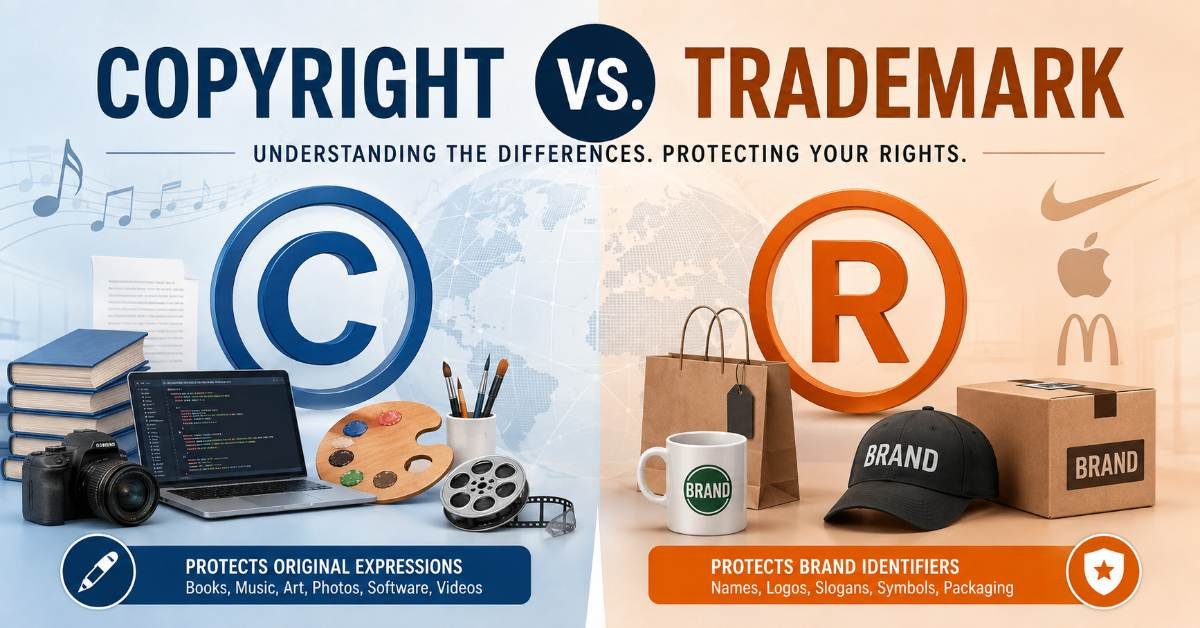
Copyright vs. Trademark vs. Patent
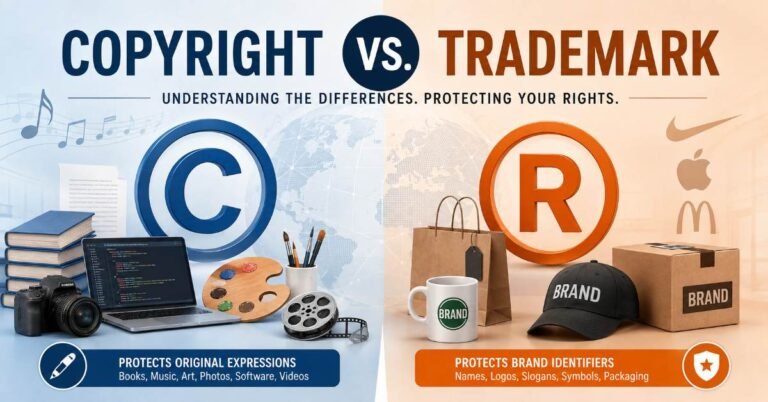
Intellectual property law encompasses several distinct disciplines. It is vital not to confuse copyright with trademarks or patents.
1. Copyright
- Primary Focus: Expressive artistic, literary, and creative works.
- Core Objective: Protects the expression of creative original work.
- Registration Requirements: Automatic (Formal registration optional).
- Protection Term: Life of author + 70 years.
2. Trademark
- Primary Focus: Brand identifiers, logos, brand names, slogans.
- Core Objective: Prevents consumer confusion in the marketplace.
- Registration Requirements: Optional, but formal registration strongly recommended.
- Protection Term: Renewable indefinitely as long as active in commerce.
3. Patent
- Primary Focus: Inventions, utility designs, chemical formulas, machines.
- Core Objective: Protects functional, practical inventions and processes.
- Registration Requirements: Mandatory thorough legal review and approval process.
- Protection Term: Typically 20 years from filing date.
Fair Use and Fair Dealing: Understanding the Exceptions
Copyright protection is not absolute. Legal doctrines such as Fair Use (in the United States) and Fair Dealing (in Commonwealth jurisdictions like the UK, Canada, and Australia) allow the limited use of copyrighted material without permission under specific conditions. You can explore real-world cases on the Stanford University Fair Use Center.
The Four Factors of Fair Use
When courts evaluate whether an unauthorized use of copyrighted material qualifies as Fair Use, they analyze four statutory factors:
- Purpose and Character of the Use: Is the use educational, non-profit, or transformative? Uses that add new meaning, commentary, or context (such as reviews or parody) are much more likely to qualify as Fair Use than commercial uses.
- Nature of the Copyrighted Work: Using material from highly creative or unpublished works is less likely to qualify as Fair Use than using excerpts from factual, published documents.
- Amount and Substantiality Used: Using a tiny excerpt or non-essential snippet is more likely to be considered fair than copying the “heart” or entire body of the work.
- Effect Upon the Potential Market: Does the unauthorized copy act as a direct market substitute that hurts the original creator’s ability to monetize their work? If yes, it rarely qualifies as Fair Use.
Copyright Infringement and Remedies
Copyright infringement occurs whenever a party exercises any of the exclusive legal rights reserved for the copyright owner without proper authorization, license, or valid statutory exemption.
Consequences of Copyright Infringement
- DMCA Takedowns & De-indexing: Online platforms remove infringing URLs, and search engines like Google strip unauthorized content from search results.
- Injunctions: Court orders requiring the infringer to cease distribution or destroy unauthorized copies immediately.
- Actual Damages: Monetary compensation equal to the financial losses suffered by the copyright holder plus profits gained by the infringer.
- Statutory Damages: Fixed monetary awards granted by law (ranging from $750 to $15,000 per infringed work in the US, up to $150,000 per work for willful infringement).
- Legal Fees: Courts may order the infringing party to reimburse the copyright owner’s legal fees.
How to Protect Your Original Content Online
If you manage a blog, website, or digital business, securing your original content online requires a proactive strategy:
- Step 1: Add a Clear Copyright Notice
- Action: Place a legible notice in your website footer:
© [Year] [Your Name/Company]. All Rights Reserved.While optional, this removes any legal defense of “innocent infringement.”
- Action: Place a legible notice in your website footer:
- Step 2: Publish Terms of Service and DMCA Policies
- Action: Display clear terms outlining how visitors may or may not use your content, along with dedicated contact details for copyright notices.
- Step 3: Monitor for Scraping and Duplicate Content
- Action: Use tools like Google Search Console or web scanning platforms like Copyscape Plagiarism Checker to detect unauthorized copying or web scraping of your articles and graphics.
- Step 4: Issue DMCA Takedown Notices
- Action: When unauthorized copies are found, issue formal takedown notices directly to the offender’s web host, domain registrar, or search engine providers.
Frequently Asked Questions (FAQs)
1. Is copyright registration mandatory?
No. Copyright protection attaches automatically as soon as your original creation is fixed in a physical or digital format. However, registering your work formally provides legal evidence and unlocks statutory damages in infringement lawsuits.
2. Can I use copyrighted music on YouTube if I give credit?
No. Giving credit to the original creator does not substitute for obtaining a license or permission. Unless the music is royalty-free, licensed under Creative Commons, or falls strictly under Fair Use, using it without permission can trigger copyright strikes or video removal.
3. What is the Creative Commons license?
Creative Commons (CC) is a flexible licensing framework that allows creators to give the public permission to share and use their creative work under specific conditions (e.g., requiring attribution, restricting commercial use, or requiring share-alike licensing).
4. What happens when a copyright expires?
When copyright protection expires, the work enters the Public Domain. Once in the public domain, anyone can copy, edit, distribute, perform, or monetize the work freely without paying royalties or seeking permission.
Summary
Copyright is an essential legal mechanism that protects creators while fostering cultural and technological progress. By understanding what copyright protects, how automatic international enforcement works under treaties like the Berne Convention, and how to utilize tools like DMCA notices, creators can confidently publish and commercialize their intellectual property online.



2 thoughts on “What Is Copyright 2026? Complete Guide to Copyright Protection & Online Rights”
Comments are closed.