
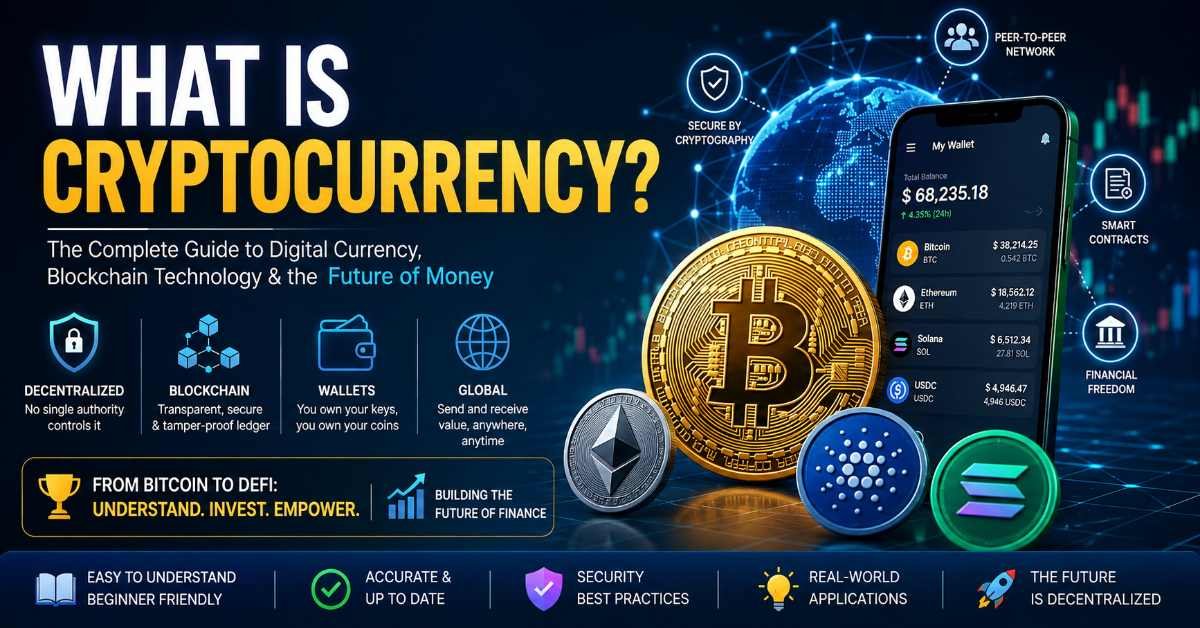
Throughout human history, money has never been a static concept. It began as direct barter—trading grain for cattle, or salt for textiles. When barter proved inefficient due to the “coincidence of wants” problem, humanity invented commodity money: cowrie shells, precious metals, and eventually stamped gold and silver coins.
As global commerce expanded, physical gold gave way to paper banknotes backed by gold reserves (the gold standard). In the 1970s, the global economy transitioned entirely to fiat currency—money backed not by physical commodities, but by government decree, sovereign trust, and central bank monetary policy.
How to Buy a House in 2026: Complete Step-by-Step Guide for First-Time Buyers
The digital revolution of the late 20th and early 21st centuries made money largely electronic. However, standard electronic money (credit card swipes, wire transfers, digital wallets like PayPal or Apple Pay) remains an electronic representation of fiat currency. Every electronic dollar, euro, or rupee is entirely controlled, monitored, and cleared by centralized financial intermediaries: commercial banks, card networks, clearinghouses, and central banks.
In 2008, an anonymous programmer (or group of programmers) writing under the pseudonym Satoshi Nakamoto published the foundational paper Bitcoin: A Peer-to-Peer Electronic Cash System.
The evolution of money follows a clear progression:
- Barter System
- Commodity Money (Gold/Silver)
- Paper Fiat Currency
- Centralized Digital Banking
- Cryptocurrency (Decentralized Digital Assets)
Nakamoto’s breakthrough solved a computational puzzle that computer scientists had wrestled with for decades: the double-spending problem. How can you create a purely digital token that can be transferred directly between two parties over the internet without a trusted third party, while guaranteeing that the sender cannot copy, duplicate, or spend that same digital asset twice?
The answer was cryptocurrency. What started as a niche experimental project among computer scientists and cryptographers has grown into a multi-trillion-dollar global asset class, fundamentally challenging our understanding of trust, governance, ownership, and value.
What Is Personal Finance 2026? Complete Guide to Budgeting, Saving & Investing
What Is Cryptocurrency? A Plain-English Explanation
To understand what is cryptocurrency, break the word into its two linguistic halves:
- “Crypto” comes from cryptography—the mathematical science of encrypting data, verifying identities, and securing communication.
- “Currency” refers to a medium of exchange, a unit of account, and a store of economic value.
At its core, a cryptocurrency is a digital, decentralized medium of exchange that uses cryptographic techniques rather than a central authority to verify transactions, manage the creation of new monetary units, and guarantee the absolute ownership of funds.
The Three Pillars of Crypto
- Cryptography: Protects keys, validates signatures, and prevents unauthorized spending.
- Decentralization: Ensures there is no single point of failure by running across thousands of independent computers globally.
- Distributed Ledger: Keeps a synchronized record of transactions spread across independent nodes without reliance on a single host.
The Difference Between Digital Fiat and Cryptocurrency
A common point of confusion is: “If my bank account is already digital, how is cryptocurrency different?”
- Digital Fiat (Your Bank Account): When you look at your mobile banking app, the balance you see is a digital ledger entry maintained by a single private corporation (your bank). The bank can freeze your account, decline a payment, limit your daily withdrawals, or charge arbitrary fees. If the bank fails or a government imposes capital controls, your access can be restricted.
- Cryptocurrency: When you own cryptocurrency in a self-custody wallet, you do not hold an entry on a corporate server. You hold mathematical proof (a cryptographic private key) that gives you exclusive, sovereign control over an asset recorded on an open, global, immutable blockchain. No single corporation or government can unilaterally censor your transaction, confiscate your coins, or artificially inflate the total supply beyond the network’s mathematical rules.
How Cryptocurrency Works: Under the Hood
Cryptocurrency works through an interconnected ecosystem of computer networks, mathematical algorithms, and data structures. Here is how each layer functions.
What Is Copyright 2026? Complete Guide to Copyright Protection & Online Rights
1. Distributed Ledger Technology (DLT) & The Blockchain
A blockchain is a specific type of distributed database. Instead of storing data on a centralized server owned by cloud giants or a bank, the database is duplicated and distributed across thousands of computers worldwide, known as nodes.
- Blocks: Transactions occurring over a given time frame (e.g., approximately every 10 minutes on Bitcoin, or every 12 seconds on Ethereum) are bundled together into a data container called a “block”.
- Chains: Each block contains a list of verified transactions, a unique mathematical fingerprint (Cryptographic Hash), and the cryptographic hash of the previous block in sequence.
Because every block contains the hash of the preceding block, they form an unbreakable mathematical chain. If an attacker attempts to alter a transaction in an earlier block, that block’s hash changes instantly. This breaks the link to all subsequent blocks, causing the entire network to reject the altered data automatically.
2. Public-Key Cryptography (Asymmetric Encryption)
Cryptocurrencies rely on asymmetric cryptography, which uses mathematically linked pairs of cryptographic keys:
- The Public Key (Your Account Number / Address): This is a long string of alphanumeric characters derived mathematically from your private key. You can freely share your public address with anyone who wants to send you funds, much like sharing your email address or bank IBAN.
- The Private Key (Your Digital Signature / Password): This is a 256-bit secret number that only you should ever know. Your private key allows your wallet software to create a unique digital signature for every outgoing transaction. This signature proves to the entire blockchain network that you are the rightful owner of the funds, without ever revealing the private key itself.
Golden Rule of Crypto Security: “Not your keys, not your coins.” If a third party holds your private keys, you hold an IOU, not the underlying asset.
3. Step-by-Step Anatomy of a Crypto Transaction
Let’s trace what happens when Alice sends 0.5 Bitcoin (BTC) to Bob:
- Initiation: Alice opens her wallet software, pastes Bob’s public address, inputs 0.5 BTC, and clicks “Send.”
- Cryptographic Signing: Alice’s wallet uses her private key to generate a unique digital signature for that specific transaction.
- Broadcasting: The transaction is broadcast to the peer-to-peer network and enters a temporary waiting room called the Mempool (memory pool).
- Validation: Network nodes check whether Alice has the necessary funds and verify that her digital signature matches her public address.
- Block Inclusion: A miner or validator groups Alice’s transaction with hundreds of others into a new candidate block and verifies it using the network’s consensus rules.
- Final Settlement: Once the block is added to the blockchain, Bob sees the 0.5 BTC in his wallet. The transaction is immutable and cannot be reversed. You can track transactions transparently using global tools like the Blockchain.com Explorer.
What Is Health Insurance? Types, Coverage, Costs & Benefits Explained
Consensus Mechanisms: How Networks Agree Without a Central Boss
In a centralized system, Visa or JPMorgan Chase decides which transactions are valid. In a decentralized network with thousands of computers, how do participants agree on the exact history of the ledger without trusting each other?
They use Consensus Mechanisms—mathematical rulebooks combined with economic game theory.
Comparison: Proof of Work vs. Proof of Stake
Proof of Work (PoW)
- Primary Resource Used: Computational power and electricity.
- Network Security Actor: Miners.
- Security Guarantee: Backed by the physical cost of energy and ASIC hardware.
- Energy Consumption: High.
- Leading Implementations: Bitcoin, Litecoin, Dogecoin.
- How It Works: Specialized computers compete against one another to solve an intensive cryptographic puzzle. The first miner to solve the puzzle earns the right to add the new block to the blockchain and receives a reward composed of newly minted coins (Block Reward) plus user transaction fees.
- Security Model: Altering the blockchain would require an attacker to control more than 50% of the entire world’s computational mining power (a 51% attack), which is economically and physically unfeasible on mature networks like Bitcoin. Detailed technical documentation is available via Bitcoin.org Core Resources.
Proof of Stake (PoS)
- Primary Resource Used: Locked capital (Cryptocurrency).
- Network Security Actor: Validators.
- Security Guarantee: Financial penalty via Slashing.
- Energy Consumption: Extremely low (>99.9% reduction compared to PoW).
- Leading Implementations: Ethereum, Solana, Cardano.
- How It Works: Instead of burning energy running computers, participants lock up (stake) their own cryptocurrency as collateral to become validators. An algorithm selects a validator to propose and validate the next block, proportional to the amount of capital staked. You can review how Ethereum transitioned to this model on the official Ethereum Staking Overview.
- Security Model (Slashing): If a validator attempts to approve fraudulent transactions or double-sign blocks, the network automatically confiscates a portion or all of their staked capital.
Alternative Consensus Architectures
- Proof of History (PoH): Used by high-performance blockchains like Solana to create a cryptographically verifiable timestamp of events before consensus, allowing processing speeds of thousands of transactions per second.
- Delegated Proof of Stake (DPoS): Token holders vote for a limited set of professional delegates to produce blocks, maximizing speed and throughput.
- Directed Acyclic Graph (DAG): Non-linear data structures where transactions validate previous transactions directly rather than waiting for sequential block creation.
The Major Categories and Types of Cryptocurrencies
The cryptocurrency market is not a monolith. There are thousands of digital assets, each serving distinct functional, economic, and technical roles. Global tracking platforms like CoinMarketCap and CoinGecko categorize these across several broad sectors.
1. Store of Value & Digital Gold (Layer-1 Payment Coins)
- Examples: Bitcoin (BTC), Litecoin (LTC).
- Purpose: Designed primarily as sovereign, scarce digital money. Bitcoin, with its hard-coded maximum supply cap of 21 million coins, functions as digital gold—an un-inflatable, borderless store of purchasing power over multi-year horizons.
2. Smart Contract Platforms & Web3 Infrastructure
- Examples: Ethereum (ETH), Solana (SOL), Avalanche (AVAX), Cardano (ADA).
- Purpose: These are programmable blockchains. Instead of just tracking token balances, they act as decentralized world computers that execute Smart Contracts (self-executing computer programs that run exactly as written without downtime, censorship, or fraud). Learn more in the official Ethereum Whitepaper.
3. Stablecoins
- Examples: Tether (USDT), USD Coin (USDC), MakerDAO (DAI).
- Purpose: Cryptocurrencies designed to maintain a stable 1:1 price parity with fiat currencies (most commonly the US Dollar). They act as the primary bridge between traditional banking and the crypto economy. You can verify reserve backing standards directly from issuers like Circle USDC Transparency.
- Fiat-Collateralized: Backed by real cash, short-term US Treasury bills, and liquid reserves held in regulated bank accounts (e.g., USDC, USDT).
- Crypto-Collateralized / Overcollateralized: Backed by excess amounts of other volatile cryptocurrencies locked in smart contracts (e.g., DAI).
4. Utility and Governance Tokens
- Examples: Uniswap (UNI), Aave (AAVE), Chainlink (LINK).
- Purpose:
- Governance Tokens: Grant holders voting rights over protocol updates, fee distributions, and treasury allocations in a Decentralized Autonomous Organization (DAO).
- Utility Tokens: Provide access to specific decentralized services (e.g., Chainlink LINK tokens pay for oracle data feeds that bring real-world data onto blockchains).
5. Layer-2 and Scaling Tokens
- Examples: Arbitrum (ARB), Optimism (OP), Polygon (POL).
- Purpose: Layer-2 networks sit on top of primary blockchains like Ethereum. They bundle hundreds of transactions off-chain, compress them, and post the mathematical proof back to Layer-1, delivering lightning-fast execution with fractional-cent fees while retaining the underlying chain’s security. Comprehensive ecosystem data can be tracked on L2BEAT.
6. Real-World Asset (RWA) Tokens
- Examples: Tokenized US Treasury bills, tokenized private credit, real estate tokens, and tokenized gold (e.g., PAXG).
- Purpose: Representing traditional financial instruments and physical physical-world assets as liquid, 24/7 tradeable tokens on public blockchains.
Fiat Currency vs. Cryptocurrency: Comprehensive Breakdown
Here is a side-by-side comparison between traditional fiat currency and cryptocurrency:
- Issuing Authority:
- Fiat: Central Governments and Central Banks.
- Cryptocurrency: Code, Protocol Rules, and Distributed Networks.
- Monetary Policy & Supply:
- Fiat: Discretionary (Subject to quantitative easing and central bank monetary targets).
- Cryptocurrency: Predictable, mathematical (Often hard-capped or algorithmic).
- Custody & Ownership:
- Fiat: Intermediated by commercial banks and financial institutions.
- Cryptocurrency: Self-custodial via private keys or custodial via exchanges.
- Censorship Resistance:
- Fiat: Low (Accounts can be frozen, funds seized, or wires blocked).
- Cryptocurrency: High (No single party can halt a valid signed transaction).
- Operating Hours:
- Fiat: Banking hours and business days (T+1 or T+2 settlement times).
- Cryptocurrency: 24 hours a day, 7 days a week, 365 days a year (Near-instant).
- Transaction Reversibility:
- Fiat: Possible (Chargebacks, dispute mechanisms, legal court orders).
- Cryptocurrency: Final and irreversible once confirmed on the blockchain.
- Transparency & Auditability:
- Fiat: Opaque (Internal bank ledgers are private and centralized).
- Cryptocurrency: Completely transparent and verifiable via open block explorers.
- Cross-Border Friction:
- Fiat: High (SWIFT network fees, currency conversion markups, multi-day delays).
- Cryptocurrency: Low (Direct peer-to-peer settlement in seconds to minutes).
The Core Advantages of Cryptocurrency
Why has cryptocurrency gained such massive global adoption? The technology provides structural solutions to legacy financial problems.
- Borderless Remittances: Send value globally in minutes at low cost without intermediary banks.
- Inflation Resistance: Fixed supply schedules (such as Bitcoin’s 21 million hard cap) protect against dilutive monetary debasement.
- Financial Inclusion: Anyone with an internet connection can access an open, global financial system.
- Programmable Money: Smart contracts automate complex financial agreements trustlessly.
1. Financial Sovereignty and Self-Custody
In the traditional banking world, your money is legally an unsecured loan to your bank. If the institution faces insolvency, bank runs, or government capital freezes, your access to capital is cut off. Cryptocurrency enables true self-sovereignty: as long as you control your private key, you have unchallengeable ownership of your digital assets.
2. Elimination of High Remittance Costs
Migrant workers worldwide lose an average of 5% to 8% of their hard-earned money when sending wages home via legacy remittance providers according to global economic monitors like the World Bank Remittance Prices Worldwide. Cryptocurrency and stablecoins allow anyone to transfer value internationally in seconds for fractions of a dollar, bypassing expensive correspondent banking networks.
3. Programmability and Decentralized Finance (DeFi)
Traditional financial products—loans, insurance, derivatives, asset exchanges—require armies of lawyers, compliance officers, underwriters, and administrative middlemen. Smart contracts automate these services entirely on-chain:
- Users can lend their assets and earn transparent yields programmatically.
- Borrowers can obtain instant, non-custodial loans backed by collateral without credit checks.
- Trades settle peer-to-peer on decentralized exchanges (DEXs) via automated liquidity pools. Detailed protocol analytics can be tracked on DeFiLlama.
4. Global Accessibility & Banking the Unbanked
Over one billion adults worldwide lack access to formal banking institutions due to documentation barriers, geographic isolation, or poverty. However, billions have smartphones and internet connectivity. Cryptocurrency provides an open financial layer: you do not need credit history, minimum balances, or government papers to generate a cryptographic wallet address and participate in global commerce.
Risks, Vulnerabilities, and Criticisms
While cryptocurrency offers remarkable innovation, it carries significant risks that every user and investor must recognize.
1. Market Volatility
Crypto markets operate 24/7 without circuit breakers or trading halts. Prices are driven by supply, demand, liquidity, macroeconomic conditions, and market sentiment. It is not uncommon for assets to fluctuate by 10% or more in a single day, or drop 70%–80% during broad multi-year bear market cycles.
2. Total Self-Custody Responsibility & Irreversibility
Decentralization is a double-edged sword. There is no customer service hotline, password reset button, or fraud department.
- If you send funds to an incorrect blockchain address, they are gone forever.
- If your computer is infected with malware and your seed phrase is stolen, your wallet can be drained instantly.
- If you lose your backup seed phrase, your funds become mathematically unrecoverable.
3. Exploits, Phishing, and Malicious Smart Contracts
The open-source nature of blockchain means malicious actors can analyze smart contracts for bugs, re-entrancy vulnerabilities, or logic flaws. Additionally, phishing scams, fake decentralized app (dApp) websites, impersonation attacks, and malicious wallet drainers cause millions of dollars in losses annually.
4. Scalability Bottlenecks
Blockchains prioritize decentralization and security, which often comes at the expense of transaction speed (the Blockchain Trilemma). When networks experience high traffic, transaction fees (gas fees) can surge, making micro-transactions expensive unless executed on Layer-2 networks or specialized high-throughput chains.
How to Buy, Store, and Protect Crypto Safely
Navigating the cryptocurrency space safely requires strict operational security (OpSec).
Understanding Wallet Types
- Custodial Wallets: An exchange holds your private keys on your behalf.
- Non-Custodial Wallets: You hold and control your own private keys.
- Hot Wallets (Connected to Internet): Software applications, mobile apps, or browser extensions (e.g., MetaMask, Phantom). Best for daily transactions and small balances, but exposed to device-level online threats.
- Cold Wallets (Air-Gapped Hardware): Physical hardware devices (e.g., Ledger, Trezor) that keep private keys completely isolated from the internet. Best for long-term storage and large amounts.
Step 1: Choosing an On-Ramp / Exchange
To convert fiat currency into cryptocurrency, users typically use a Centralized Exchange (CEX):
- Pick a well-regulated exchange with high liquidity, strong regulatory compliance, Proof-of-Reserves audits, and mandatory two-factor authentication (2FA).
- Complete identity verification (KYC) by submitting your government-issued ID.
Step 2: Best Security Protocols
- Write Down Your Recovery Seed Phrase on Paper or Metal: Never store your 12- or 24-word recovery phrase in a screenshot, cloud storage, notes app, or email.
- Never Share Your Seed Phrase: Legitimate support agents, wallet creators, and platforms will never ask for your seed phrase. Anyone requesting it is attempting to steal your funds.
- Use Hardware 2FA: Protect your exchange accounts with hardware security keys (e.g., YubiKey) or authenticator apps. Never rely on SMS-based 2FA due to SIM-swapping risks.
- Test With Small Amounts First: When sending a large transaction, always send a small test transfer first to verify the destination address and network chain.
Global Regulations, Compliance, and Taxation
The regulatory landscape for cryptocurrency is maturing rapidly from an era of legal ambiguity into structured compliance frameworks worldwide.
Overview of Major Regulatory Frameworks
- European Union: The European Commission Markets in Crypto-Assets (MiCA) provides a unified framework governing stablecoin issuance, exchange licensing, and consumer protection.
- United States: Dual oversight under the U.S. Securities and Exchange Commission (SEC) and CFTC, approved spot crypto ETFs, and expanding legislative structuring for digital asset market oversight.
- Asia-Pacific: Progressive regulatory hubs in Singapore (Monetary Authority of Singapore – MAS), Hong Kong, and the UAE focused on clear institutional licensing and digital asset custody frameworks.
- Tax Treatment: Treated as property or capital assets in most jurisdictions. Capital gains tax applies to trading, selling, spending, or staking rewards.
1. The Shift to Institutional-Grade Rules
Global bodies such as the Financial Action Task Force (FATF) enforce the Travel Rule, requiring crypto asset service providers (CASPs) to share sender and recipient identifying data for transactions above certain thresholds. The European Union’s MiCA framework sets a global benchmark for clear licensing, reserve asset audits for stablecoins, and market-abuse safeguards.
2. Cryptocurrency Taxation Fundamentals
In almost all major economies, cryptocurrencies are classified as property or capital assets, not tax-exempt legal tender.
- Taxable Events: Selling crypto for fiat currency, trading one cryptocurrency for another, spending crypto on goods/services, and earning income through staking, mining, or airdrops.
- Non-Taxable Events (in most countries): Buying crypto with fiat and holding it in your wallet, or transferring coins between your own self-custody wallets. Official guidance can be reviewed directly on revenue service portals like the IRS Digital Assets Guide.
How to Save Money: 25 Smart Ways to Cut Expenses & Build Wealth
Real-World Applications Beyond Price Speculation
Cryptocurrency is not just about trading price charts. The underlying technology powers real economic and industrial systems:
- Tokenized Real-World Assets (RWAs): Major global financial institutions are putting tokenized versions of sovereign bonds, money-market funds, and private credit on public blockchains to enable instant 24/7 settlement and fractional ownership.
- Decentralized Physical Infrastructure (DePIN): Projects incentivize individuals to deploy physical hardware—such as 5G hotspots, environmental sensors, or decentralized GPU computing clusters—in exchange for protocol token rewards.
- Decentralized Identity (DID): Cryptographic key pairs allow users to verify their identity, age, or professional credentials without handing over raw personal data to centralized platforms via frameworks outlined by the W3C Decentralized Identifiers.
- AI-to-AI Micro-Transactions: As autonomous AI agents conduct tasks, purchase data feeds, and rent compute resources, they cannot open bank accounts. Cryptocurrencies and stablecoins serve as the native, programmable financial rails for the automated machine economy.
The Future Outlook: Emerging Trends and Technology
As the ecosystem expands, several technological and macroeconomic trends are driving the next wave of evolution:
- Spot Exchange-Traded Products (ETFs) & Institutional Capital: The integration of digital assets into traditional pension funds, wealth management portfolios, and corporate treasuries has cemented crypto as a recognized macro asset class.
- Zero-Knowledge (ZK) Cryptography: ZK-Rollups and Zero-Knowledge Proofs allow networks to verify complex transactions without revealing sensitive underlying data, delivering massive privacy and scalability improvements.
- Central Bank Digital Currencies (CBDCs) vs. Open Crypto: Many central banks are testing state-backed digital currencies, tracked globally on the Atlantic Council CBDC Tracker. Unlike decentralized cryptocurrencies, CBDCs are fully centralized and surveillance-capable, creating a clear philosophical contrast with permissionless open-source networks like Bitcoin and Ethereum.
Frequently Asked Questions (FAQ)
What is cryptocurrency in simple words?
Cryptocurrency is digital money that is not issued or controlled by any government or bank. It uses advanced mathematics and a decentralized network of computers to ensure that money cannot be duplicated, forged, or stolen.
Is cryptocurrency real money?
Yes. Like traditional currency, cryptocurrency functions as a medium of exchange and a store of value. It can be used to purchase goods, pay for services, trade for other assets, or convert directly back into fiat currency like US Dollars or Euros.
Can cryptocurrency be converted into cash?
Yes. You can convert cryptocurrency into cash through centralized crypto exchanges, peer-to-peer (P2P) trading platforms, crypto debit cards, or specialized Bitcoin ATMs.
What makes Bitcoin and other cryptocurrencies valuable?
Cryptocurrency value is determined by supply and demand. Factors that give it value include mathematical scarcity (Bitcoin has a fixed limit of 21 million units), utility (executing smart contracts and international transfers), and network effects (developer adoption and computing security).
What is the difference between a coin and a token?
- A Crypto Coin operates on its own independent native blockchain (e.g., Bitcoin on the Bitcoin network, Ether on the Ethereum network, SOL on Solana).
- A Crypto Token is built on top of an existing blockchain using smart contract standards (e.g., USDT or Uniswap UNI built on Ethereum as ERC-20 tokens).
Is cryptocurrency legal?
In the vast majority of countries—including the United States, European Union member states, the UK, Canada, Australia, India, and Japan—buying, selling, and holding cryptocurrency is legal, subject to local tax and financial compliance regulations. Only a small number of jurisdictions have outright prohibitions.
Final Thoughts & Key Takeaways
Understanding what is cryptocurrency requires looking past the day-to-day market hype and recognizing the underlying structural breakthrough: a neutral, transparent, and mathematically governed monetary infrastructure for the digital age.
- Key Takeaway 1: Cryptocurrencies replace centralized institutional trust with mathematical and cryptographic proof.
- Key Takeaway 2: Blockchain technology provides transparent, immutable, and tamper-resistant record-keeping across distributed global nodes.
- Key Takeaway 3: While self-sovereignty offers unparalleled financial freedom, it demands complete personal responsibility for security, wallet management, and risk mitigation.
- Key Takeaway 4: As regulation matures, scalability improves, and institutional adoption expands, cryptocurrency continues to evolve from an experimental technological concept into a core pillar of the modern global economy.




2 thoughts on “What Is Cryptocurrency 2026? How Crypto, Bitcoin & Blockchain Work”
Comments are closed.