
Building a business demands vision, strategy, and relentless dedication. You spend countless months choosing the perfect company name, designing an iconic logo, and crafting a catchy slogan. But what happens if a competitor across town—or an e-commerce vendor across the globe—starts using your exact name and logo?
Without formal brand protection, your business identity remains exposed. That is where intellectual property law steps in to safeguard your hard work.
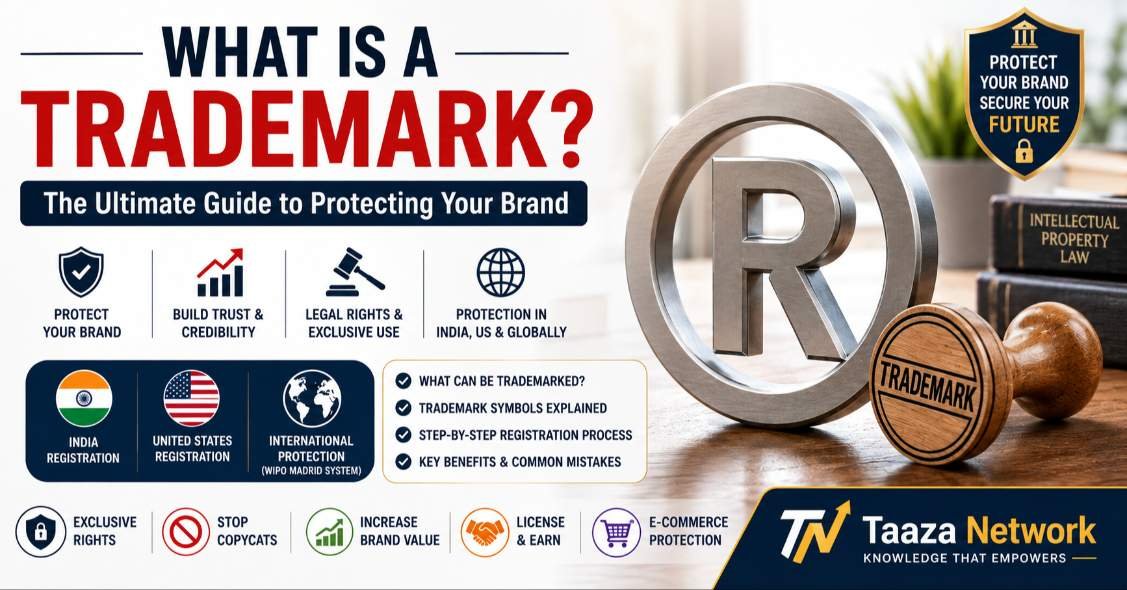
If you have ever asked yourself, “What is a trademark?”, how it works across international borders, or how to register one in India, the United States, or globally, this comprehensive guide provides everything you need to know.

What Is Life Insurance ? Complete Guide to Coverage, Types & Benefits
What Is a Trademark?
At its core, a trademark is a distinctive sign, word, symbol, phrase, design, or combination of these elements that identifies the goods or services of a specific business and distinguishes them from competitors in the marketplace.
In practical terms, a trademark acts as your brand’s legal fingerprint. It signals to consumers: “This product comes from us, and it carries our guaranteed quality and reputation.”
The Fundamental Functions of a Trademark
- Source Identification: It explicitly reveals to buyers who made the product or provided the service.
- Quality Assurance: It promises consumers that products carrying the mark will consistently meet the brand’s expected standard.
- Brand Protection: It builds brand recognition and serves as the anchor for all corporate marketing and advertising.
- Legal Monopoly: It gives the owner exclusive rights, preventing unauthorized third parties from using confusingly similar marks.
Healthy Lifestyle: The Ultimate Science-Backed Guide to Physical, Mental, and Emotional Well-Being
What Can (and Cannot) Be Trademarked?
Many entrepreneurs assume a trademark only covers a business name or logo. However, modern intellectual property laws allow you to register a wide range of brand elements.
Brand Elements You Can Trademark
- Words and Brand Names: Apple, Nike, Tata, Samsung.
- Product Names: iPhone, PlayStation, Mustang, Big Mac.
- Slogans and Taglines: “Just Do It” (Nike), “I’m Lovin’ It” (McDonald’s), “Utterly Butterly Delicious” (Amul).
- Logos and Symbols: The Nike Swoosh, the Mercedes-Benz star, or the Apple logo.
- Non-Traditional Trademarks: Distinctive sounds (like the NBC chime), specific brand colors (like Tiffany Blue), and unique shapes or packaging (like the Coca-Cola contour bottle).
What CANNOT Be Trademarked?
To qualify for trademark protection, an asset must be inherently distinctive. You cannot trademark:
- Generic Terms: Words like “Coffee” for a café or “Books” for a bookstore.
- Merely Descriptive Words: Phrases like “Cold Ice Cream” or “Fast Delivery Service.”
- Deceptive Marks: Symbols or words that mislead consumers about the origin, nature, or quality of the goods.
- Offensive or Prohibited Signs: National flags, government seals, or immoral representations.
Trademark vs. Copyright vs. Patent
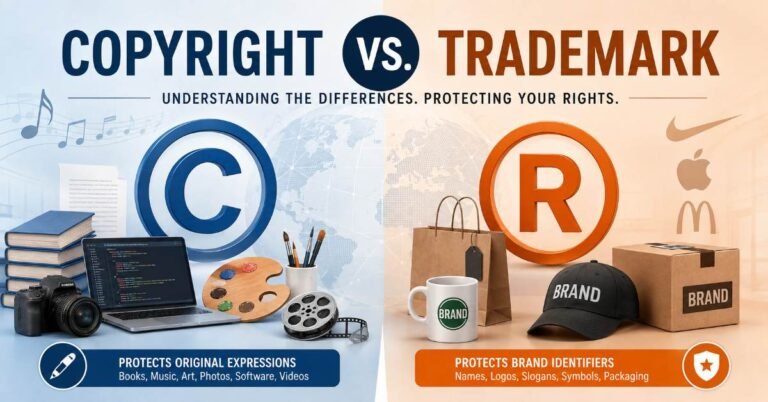
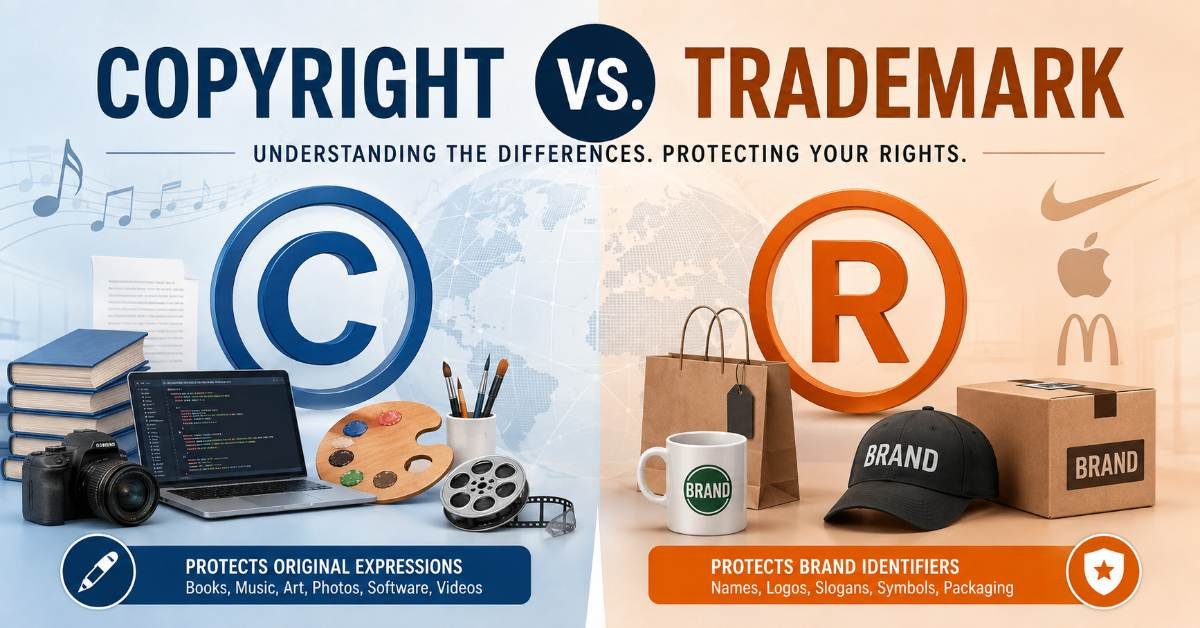
A common challenge for business owners is understanding how trademarks differ from copyrights and patents. While all three protect Intellectual Property (IP), each serves a distinct legal purpose:
1. Trademark
- Primary Focus: Brand Identity (names, logos, taglines, symbols).
- Core Purpose: To prevent consumer confusion and protect commercial goodwill in the marketplace.
- Lifespan: Indefinite, provided you continuously use the mark and renew your registration (typically every 10 years).
2. Copyright
- Primary Focus: Original creative and artistic works (novels, music, software code, movies, paintings).
- Core Purpose: To prevent unauthorized copying or reproduction of creative expression.
- Lifespan: Generally the author’s life plus 60 to 70 years, depending on regional laws.
3. Patent
- Primary Focus: Inventions, technological processes, mechanical designs, and chemical formulas.
- Core Purpose: To grant exclusive rights to make, use, or sell a novel technical invention.
- Lifespan: Fixed at 20 years from the filing date (non-renewable).
How to Save Money: 25 Smart Ways to Cut Expenses & Build Wealth
Trademark Symbols Explained: ™ vs. ℠ vs. ®
You see small superscript symbols attached to brand names every day. Each symbol carries a specific legal meaning:
The ™ Symbol (Unregistered Trademark)
This symbol informs the public that you claim common-law ownership over a brand name, word, or logo. You can use the ™ symbol immediately on your assets without filing any formal government applications.
The ℠ Symbol (Service Mark)
This symbol works identically to the ™ symbol, but it is specifically tailored for companies offering services (such as consulting, banking, or logistics) rather than physical goods.
The ® Symbol (Registered Trademark)
This symbol indicates that your trademark has been officially granted and registered by a government intellectual property office.
- Important Legal Note: It is illegal to use the ® symbol next to a brand element until your trademark application has been fully approved and certified by an official government registry.
Key Benefits of Registering a Trademark
Whether you run a local enterprise in Mumbai, a tech firm in California, or an e-commerce platform catering to international buyers, registering your trademark offers significant commercial advantages:
- Exclusive Legal Rights: Registration grants legal ownership across your jurisdiction, making it easier to shut down copycats and win lawsuits against infringers.
- Protection Against Counterfeiting: It stops unauthorized sellers from using your reputation to trick buyers into purchasing counterfeit goods.
- Appreciating Business Asset: As your company matures, your trademark increases in financial value. You can license it to franchisees, pledge it for bank loans, or sell it outright.
- E-Commerce and Marketplace Clearance: Major global online marketplaces (such as Amazon and eBay) require official trademark registration to grant brand-registry access and auto-enforcement protection.
What Is a Personal Loan? The Smart Way to Borrow in 2026
How to Register a Trademark: Step-by-Step
While trademark principles are similar worldwide, actual registration processes depend on where you operate. Here is how the process works in India, the United States, and globally.
1. Registering a Trademark in India
In India, trademark registration is governed by the Trademarks Act, 1999 and administered by the Controller General of Patents, Designs and Trade Marks (CGPDTM).
The Indian Process:
- Conduct a Public Search: Start by searching existing database entries to ensure your proposed name or logo is available. You can run a free search on the official IP India Public Search Portal.
- Select Your Class: Trademarks are organized into 45 international classes under the NICE Classification system (Classes 1–34 cover products; Classes 35–45 cover services).
- Submit Form TM-A: File your application online via the official e-filing platform. Statutory fees are discounted for Individuals, Startups, and Small Enterprises (MSMEs).
- Government Examination: An examiner reviews your application. If they raise objections under Section 9 (lack of distinctiveness) or Section 11 (conflict with existing marks), you must file a legal response within 30 days.
- Journal Publication: Once approved, your mark is published in the weekly Trademarks Journal. This gives the public a 4-month window to raise oppositions.
- Certificate Issuance: If no opposition is filed, the Registrar issues your official Trademark Registration Certificate.
2. Registering a Trademark in the United States
In the US, federal trademark registration is managed by the United States Patent and Trademark Office (USPTO).
The US Process:
- Run a Comprehensive Search: Search active and dead federal records using the official search tools on the United States Patent and Trademark Office (USPTO) platform.
- Determine Filing Basis: You must choose between Use in Commerce (Section 1a) if you are already selling products across state lines, or Intent to Use (Section 1b) if you plan to introduce the brand soon.
- File an Online Application: Submit your application through the USPTO’s electronic system along with the required statutory filing fees.
- Examining Attorney Review: A USPTO attorney evaluates your application for “likelihood of confusion” with existing marks. If issues are identified, they will issue an Office Action.
- Publication in the Official Gazette: If approved, your mark is published in the Official Gazette for a 30-day opposition period.
- Final Registration: For “Use in Commerce” filings, the USPTO issues your registration certificate shortly after the opposition period closes.
3. International Trademark Protection for Global Businesses
Because trademark rights are territorial, a registration in India or the US will not protect your brand in Europe, Asia, or Latin America.
To protect your brand across multiple international markets efficiently, you can use the Madrid System, operated by the World Intellectual Property Organization (WIPO).
How Global Registration Works:
- Instead of filing separate applications in dozens of countries, you can file a single international application through your home trademark office.
- You can designate any of the 130+ member countries covered by the Madrid Protocol.
- You can manage international fees, renewals, and geographical expansions through the official World Intellectual Property Organization (WIPO) portal.
Critical Trademark Mistakes to Avoid
Securing a trademark requires careful planning. Avoid these common mistakes:
- Relying Only on a Google Search: A quick internet search is not enough. A business might own active trademark rights even if they do not maintain an active website.
- Choosing Weak or Descriptive Names: Names that simply describe what a product does (e.g., “Fast Car Repair”) receive weak legal protection compared to coined/fanciful names (e.g., Kodak) or arbitrary names (e.g., Apple for computers).
- Filing in the Wrong Trademark Class: If you register your brand under retail services instead of physical product manufacturing, your actual merchandise remains vulnerable.
- Neglecting Brand Maintenance: Trademarks require ongoing enforcement. If you allow third parties to use your mark freely, your brand can suffer from genericide—losing its trademark protection because the name becomes a common dictionary term (like Escalator or Aspirin).
Frequently Asked Questions (FAQs)
How long does a trademark registration last?
A trademark registration is typically valid for 10 years from the filing date. You can renew it indefinitely every 10 years, provided you prove the mark is still actively used in commerce.
How long does the registration process take?
- In India: Usually takes 6 to 12 months if no objections or oppositions are filed.
- In the US: Generally takes 12 to 18 months due to examination processing times.
- Internationally: Through WIPO, processing times vary between 12 to 18 months depending on the specific countries designated.
Does buying a .com domain name give me trademark rights?
No. Registering a website domain name only secures the web address URL. It does not provide legal ownership over the brand name or stop competitors from using the same name for their physical goods or services.
Can I register a trademark without a lawyer?
Yes, individuals and business owners are allowed to file applications directly with their respective government IP offices. However, working with a qualified trademark attorney minimizes errors, speeds up response times for government objections, and ensures proper classification.
Summary
Understanding what a trademark is and taking proactive steps to register your brand identity is one of the most critical legal investments you can make for your company. A registered trademark protects your business reputation, deters copycats, and builds long-term economic value as your business expands globally.





2 thoughts on “What Is a Trademark? Complete Guide to Brand Protection”
Comments are closed.