
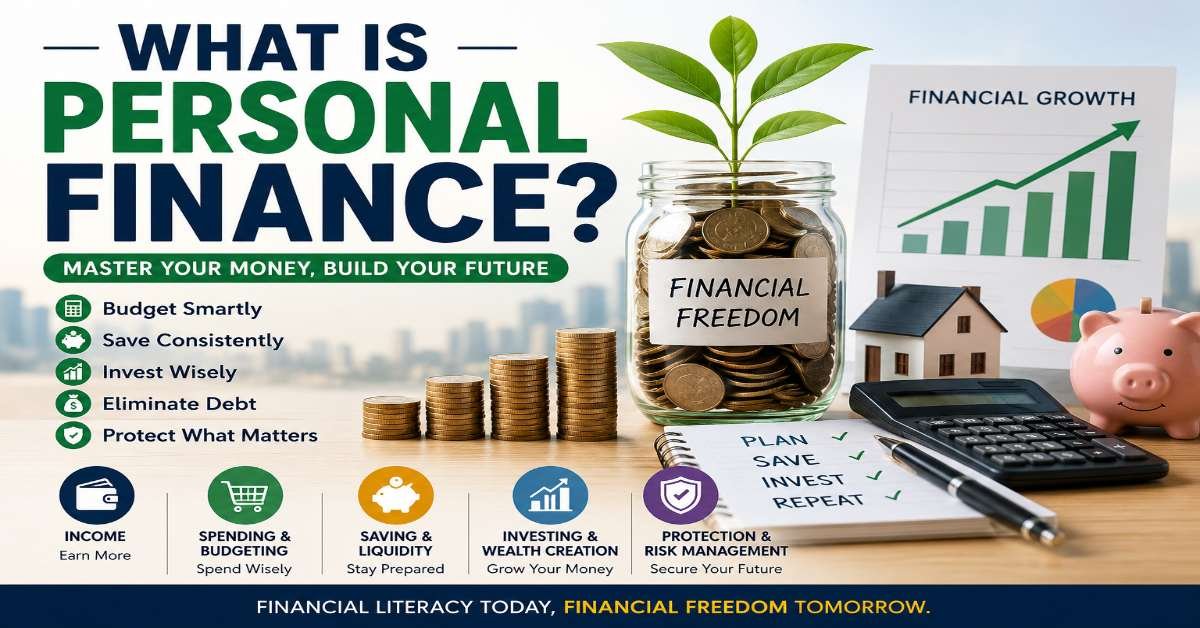
When people hear the term money management, they often visualize complex mathematical formulas, Wall Street stock charts, or intimidating accounting spreadsheets. But fundamentally, what is personal finance?
At its core, personal finance is the art and science of managing your individual or household money. It encompasses every financial decision you make throughout your life—how you earn income, spend daily cash, save for unexpected emergencies, invest for long-term growth, and protect your hard-earned assets against unforeseen catastrophic events.
What Is Copyright 2026? Complete Guide to Copyright Protection & Online Rights
Personal finance is not merely about math; it is deeply behavioral, psychological, and contextual. It is the practical toolkit that converts your time and labor into financial independence, security, and freedom. Whether you are aiming to buy your first home, pay off student loans, launch a business, or retire comfortably in your golden years, personal finance is the road map that bridges the gap between where you are today and where you want to be tomorrow.
In simple terms, personal finance moves through a natural lifecycle: you earn income through active or passive streams, control your spending cash flow, build liquid emergency reserves, invest in global equities or real estate, and safeguard everything with a solid protection layer of health and life insurance.
What Is Health Insurance? Types, Coverage, Costs & Benefits Explained

Why Personal Finance Matters More Than Ever
In the modern global economy, financial literacy is no longer an option—it is a critical life skill. Several macroeconomic factors make understanding what is personal finance vital for everyone worldwide:
- Global Economic Volatility: Inflation, currency fluctuations, and shifting interest rates impact living costs regardless of where you reside. You can monitor global monetary trends directly on The International Monetary Fund.
- Shifting Retirement Landscapes: Traditional government-backed pension plans are diminishing across many nations, shifting the responsibility of retirement planning directly onto the individual.
- Access to Credit & Consumer Debt: Credit cards, buy-now-pay-later schemes, and easy consumer loans make it effortless to fall into debt traps if cash flow is not actively monitored.
- The Rise of the Gig Economy: Millions of individuals worldwide now operate as freelancers, contractors, or digital nomads, requiring self-directed taxation, income stabilization, and private insurance arrangements.
Mastering personal finance gives you agency over your destiny, turning money from a constant source of anxiety into an effective instrument for personal fulfillment.
What Is a Trademark? Complete Guide to Brand Protection

The 5 Core Pillars of Personal Finance
To build a solid financial house, you must construct it on a durable foundation. Personal finance can be broken down into five primary pillars:
1. Income
Income is the entry point of all financial activity. It refers to all cash inflows coming into your household ecosystem.
- Active Income: Salaries, hourly wages, freelance fees, and performance bonuses.
- Passive/Investment Income: Dividends, bond yields, rental property returns, royalties, and business profits.
- Side Hustles: Secondary revenue streams generated through specialized digital skills, consulting, or e-commerce.
Increasing your earning potential—whether through upskilling, career negotiation, or creating secondary income streams—accelerates every other area of your personal finances.
2. Spending & Budgeting
Spending represents all cash outflows. It dictates how much of your hard-earned income you retain versus how much leaves your pocket.
- Fixed Expenses: Rent, mortgage, insurance premiums, utility bills, subscription contracts.
- Variable Expenses: Groceries, dining out, entertainment, shopping, travel.
If spending exceeds income, you operate at a net deficit, which inevitably leads to debt accumulation. If spending is lower than income, you generate a cash surplus—the engine that fuels savings and wealth accumulation.
What Is Life Insurance ? Complete Guide to Coverage, Types & Benefits
3. Saving & Liquidity
Saving is the process of setting aside leftover income in safe, highly liquid financial instruments.
- Emergency Funds: Cash reserves held to cushion against sudden job loss, medical emergencies, or repair costs.
- Short-Term Targets: Capital designated for purchases expected within 1 to 3 years like travel, home down payments, or vehicle purchases.
Savings should ideally be held in vehicles like High-Yield Savings Accounts (HYSAs) or money market funds to preserve capital while offsetting inflation.
4. Investing & Wealth Creation
While saving protects your principal capital, investing puts your money to work to grow wealth over time. Investing involves purchasing assets that have the potential to generate capital appreciation, interest, dividends, or rental income over a multi-year horizon.
- Equities: Public company stocks and index funds.
- Fixed Income: Government and corporate bonds.
- Real Estate: Residential, commercial, or real estate investment trusts.
- Commodities & Digital Assets: Gold, silver, and digital assets.
Investing is essential to combat inflation. When inflation rises, cash sitting idle in standard bank accounts loses purchasing power each year.
5. Protection & Risk Management
Protection involves insulating your wealth from catastrophic, low-probability events that could financially devastate you or your family.
- Health Insurance: Covers high-cost medical emergencies and hospital stays.
- Life Insurance: Ensures financial continuity for dependents in the event of an untimely death.
- Disability & Income Protection: Replaces income if you are injured or unable to work.
- Property & Liability Insurance: Protects high-value physical assets like homes and vehicles from disaster or lawsuit liabilities.
What Is Life Insurance ? Complete Guide to Coverage, Types & Benefits
Mastering Cash Flow: Modern Budgeting Frameworks
A budget is not a financial straightjacket intended to restrict joy; it is a permission structure for intentional spending. A proper budget ensures every dollar, euro, or rupee has a clear purpose.
The 50/30/20 Rule
Popularized by personal finance experts worldwide, the 50/30/20 rule is an intuitive framework designed to keep cash allocation balanced:
- 50% for Needs: Essential expenses you cannot avoid such as rent or mortgage, basic groceries, utilities, minimum debt payments, and transit.
- 30% for Wants: Discretionary choices that enhance lifestyle like restaurant meals, streaming services, concerts, and vacations.
- 20% for Savings & Debt Payoff: Money routed directly toward building an emergency fund, investing in retirement, or accelerating debt repayments beyond minimums.
Zero-Based Budgeting
In Zero-Based Budgeting, your income minus expenses equals zero. At the start of each month, every unit of currency earned is pre-assigned to a specific category—whether that is rent, groceries, stock market investments, or a weekend getaway. Nothing is left unallocated in your checking account, preventing mindlessly leaking money.
The Envelope & Bucket Systems
- Physical or Digital Envelope System: Allocating hard cash or digital budget envelopes for volatile categories like dining out or shopping. Once the envelope is empty, spending in that category stops until the next pay period.
- Multi-Account Bucket System: Utilizing multiple bank accounts such as an Income account, Fixed Expenses account, Emergency account, and Fun/Spending account to separate money visually and prevent accidental overspending.
Strategic Debt Elimination: Reclaiming Your Income
Debt is one of the double-edged swords in personal finance. Used strategically, it can build long-term value; used recklessly, it compounding consumes future earnings through interest fees.
Good Debt vs. Bad Debt
Good debt is defined as debt that finances assets that grow in value or increase income capacity. Typical examples include student loans for high-ROI degrees, business expansion loans, or residential mortgages. These generally carry low to moderate interest rates.
Bad debt refers to debt used to finance depreciating consumer goods or non-essential lifestyle choices. Typical examples include high-interest credit cards, payday loans, or financing high-end luxury items. These often carry exorbitant interest rates that destroy wealth through compounding interest expenses.
Healthy Lifestyle: The Ultimate Science-Backed Guide to Physical, Mental, and Emotional Well-Being
Debt Snowball vs. Debt Avalanche
If you carry multiple debts, two proven methodologies can help eliminate them systematically:
- The Debt Snowball Method:
- Strategy: List all debts from smallest balance to largest balance, regardless of interest rate. Pay minimums on all, and put every spare cent toward the smallest debt until it is completely wiped out.
- Advantage: Focuses on psychological wins and delivers quick mental momentum that keeps you motivated over time.
- The Debt Avalanche Method:
- Strategy: List all debts from highest interest rate to lowest interest rate. Pay minimums on all, and funnel surplus cash into the debt carrying the highest interest rate.
- Advantage: Focuses on mathematical efficiency, saving you the maximum total interest and providing a faster path out of debt. You can read more about interest rate calculations on Investopedia.
The Power of Compound Interest & Early Saving
Albert Einstein allegedly referred to compound interest as the eighth wonder of the world. In personal finance, compounding occurs when you earn returns not only on your initial principal capital but also on the accumulated interest or dividends from previous periods.
The mathematical formula for compound interest is:
A = P \left(1 + \frac{r}{n}\right)^{nt}
Where:
- A = Final amount accumulated
- P = Principal amount (initial investment)
- r = Annual interest rate (decimal)
- n = Number of times interest is compounded per year
- t = Time in years
The Impact of Starting Early
Consider two hypothetical investors, Alex and Jordan, who each earn an average annual return of 8%:
Alex starts investing $300 per month at age 22. By age 62 (40 years of continuous investing), Alex has contributed $144,000 in total capital. Thanks to compound interest, Alex’s portfolio grows to approximately $1,047,000.
Jordan delays starting until age 32 and invests the exact same $300 per month for 30 years until age 62. Jordan contributes $108,000 in total capital. Jordan’s final portfolio stands at approximately $447,000.
Because Alex started 10 years earlier, Alex accumulated over $600,000 more in total wealth while contributing only $36,000 more out-of-pocket. Time in the market beats timing the market. You can test your own figures using tools provided by the U.S. Securities and Exchange Commission.
Investing 101: Building Global Wealth
Understanding what is personal finance requires moving beyond simple cash preservation into long-term asset accumulation across different risk levels:
- High Risk Level: Equities, emerging market funds, digital assets, and venture capital.
- Moderate Risk Level: Real Estate, corporate bonds, and dividend-paying equities.
- Low Risk Level: Government Treasury bills, cash equivalents, and physical gold.
Asset Classes Explained
- Equities (Stocks): Represent ownership shares in publicly traded corporations. High long-term growth potential, accompanied by short-term market volatility.
- Fixed Income (Bonds): Debt instruments issued by governments or corporations. In exchange for your loan, they pay regular fixed interest payments and return principal at maturity.
- Real Estate: Direct ownership of residential or commercial property, or indirect ownership through Real Estate Investment Trusts (REITs). Provides rental income and potential property appreciation.
- Cash & Equivalents: Money market funds, certificates of deposit (CDs), and Treasury bills offering high safety and liquidity, but lower yield.
Index Funds, ETFs, and Equities
For the vast majority of investors globally, trying to hand-pick individual stock winners is a difficult task. Academic literature consistently demonstrates that passive index investing outperforms most actively managed funds over multi-decade horizons.
Broad-Market Index Funds and ETFs track major indices like the S&P 500, MSCI World Index, or FTSE Developed World Index. By purchasing a single fund share, you automatically own a fractional slice of hundreds or thousands of top global companies. Broad diversification dramatically lowers un-systematic single-stock risk without sacrificing market returns.
Diversification & Asset Allocation
Asset allocation is the process of dividing your portfolio among different asset categories according to your age, risk tolerance, and time horizon.
A common thumb-rule for equity allocation is:
\text{Percentage of Stocks} = 110 - \text{Your Age}
For example, a 25-year-old would aim for approximately 85% in equities and 15% in bonds or cash, whereas a 55-year-old would target roughly 55% in equities and 45% in bonds or cash.
Retirement Planning & The FIRE Movement
Retirement planning means structuring your financial assets so you can maintain your preferred lifestyle after you stop working active jobs.
Standard Retirement Accounts
Depending on where you reside globally, tax-advantaged accounts offer incentives to encourage long-term retirement savings:
- United States: 401(k), Traditional IRA, Roth IRA.
- United Kingdom: Individual Savings Accounts (ISAs), Personal Pensions (SIPPs).
- Canada: Tax-Free Savings Account (TFSA), Registered Retirement Savings Plan (RRSP).
- Australia: Superannuation system.
- India: Public Provident Fund (PPF), National Pension System (NPS).
Utilizing these tax-advantaged structures lowers your taxable income today or provides tax-free withdrawals in retirement.
The FIRE Movement (Financial Independence, Retire Early)
In recent years, the global FIRE movement has gained popularity among younger professionals. FIRE advocates focus on extreme savings rates (often 50% to 70% of income), frugal living, and index fund investing to achieve financial independence decades before traditional retirement age.
The fundamental math behind FIRE relies on the 4% Rule, which suggests that once your total invested net worth equals 25 times your annual living expenses, you can safely withdraw 4% per year (adjusted for inflation) with minimal risk of running out of money over a 30-year period.
How to Save Money: 25 Smart Ways to Cut Expenses & Build Wealth
Insurance and Risk Management: Safeguard Your Net Worth
Building wealth without insurance is like building a castle on sand—one severe storm can cause the structure to collapse. Risk management involves transferring catastrophic financial loss to an insurance issuer.
Essential Risk Management Coverage
- Health Insurance: Covers major medical and surgical costs to prevent medical bankruptcy.
- Term Life Insurance: Replaces income for dependents if you pass away during your peak earning years. Pure Term Life Insurance is generally far more cost-effective than complex whole life products.
- Disability Insurance: Protects against loss of earning ability if an illness or accident prevents you from working.
- Asset Insurance: Covers high-value physical assets like rental properties, homes, and vehicles from disaster or lawsuit liabilities.
The Psychology of Money: Behavioral Finance
Understanding the technical aspects of what is personal finance is only half the battle. Doing well with money has little to do with how smart you are and a lot to do with how you behave.
Common Behavioral Biases in Finance
- Lifestyle Creep: The natural tendency to increase discretionary spending every time income increases, keeping personal savings flat despite earning higher salaries.
- Loss Aversion: The psychological phenomenon where the pain of losing money is twice as intense as the joy of making an equivalent gain. This bias often causes investors to panic-sell at market bottoms.
- FOMO (Fear Of Missing Out): Speculating in unproven investments or chasing asset bubbles simply because friends or social media influencers are making fast gains.
- Anchoring Bias: Becoming obsessed with the price you originally paid for an asset rather than its actual forward-looking fundamentals.
Building wealth requires emotional control, discipline, patience, and delayed gratification.
Fintech, Digital Assets, and Global Banking
The evolution of technology has altered how humanity interacts with money. Modern consumers have access to tools that were unimaginable a generation ago:
- Neobanks & Digital Banking: Digital-only banking platforms offer international money transfers with minimal FX spreads, high yield returns, and built-in cash flow tracking.
- Automated Robo-Advisors: Platforms that automatically construct, balance, and rebalance low-cost index portfolios using algorithms.
- Cross-Border Remittances: Blockchains and fintech platforms enable fast borderless transactions, reducing fee frictions for global workers.
- Central Bank Digital Currencies (CBDCs) & Digital Assets: Cryptocurrencies like Bitcoin and Ethereum have created new conversations around monetary sovereignty, inflation hedges, and decentralized finance. You can explore global financial stability research through The World Bank.
A Step-by-Step Financial Action Plan
If you want to take control of your financial life today, follow this sequential roadmap:
- Calculate Your Net Worth: Total Assets (cash, investments, home value) minus Total Liabilities (debts, loans, credit balances). Track this number quarterly.
- Establish a Starter Emergency Fund: Put away 1 month of basic living expenses in an accessible high-yield account before taking major financial risks.
- Eliminate High-Interest Debt: Eliminate toxic consumer debts with interest rates exceeding 8-10% APR using the Avalanche or Snowball method.
- Fully Fund Your Emergency Reserve: Expand your reserve to 3 to 6 months of true living expenses.
- Capture Employer Match: If your employer offers a retirement matching contribution, invest enough to claim the full match—it is an instant 100% return on investment.
- Automate Wealth Building: Set up recurring monthly transfers from your checking account into low-cost broad-market index funds, ETFs, or retirement accounts.
- Review and Optimize Annually: Rebalance your portfolio, review insurance policies, re-evaluate career compensation, and update estate plans once per year.
Frequently Asked Questions (FAQs)
What is the simplest definition of personal finance?
Personal finance is the practical management of your personal money—including earning, spending, budgeting, saving, investing, and risk protection over your lifetime.
What is the 50/30/20 rule in personal finance?
The 50/30/20 rule is a simple budgeting guideline that suggests allocating 50% of your net income toward essential Needs, 30% toward discretionary Wants, and 20% toward Savings and Debt elimination.
How much money should I keep in an emergency fund?
Most financial advisors recommend keeping between 3 to 6 months’ worth of essential living expenses in a liquid high-yield savings account to buffer against sudden job loss or emergencies.
Is saving money enough to build wealth?
No. While saving protects your principal capital, cash sitting idle loses purchasing power over time due to inflation. To build long-term wealth, you must invest in inflation-beating assets like equities, index funds, or real estate.
What is the difference between personal finance and corporate finance?
Personal finance deals with individual or household financial management, budgeting, and lifestyle goals, whereas corporate finance focuses on how corporations manage funding, capital structures, balance sheets, and business investments.
Conclusion & Next Steps
Understanding what is personal finance is the foundation for achieving true financial independence. It is not about living a life of extreme sacrifice, but about making intentional choices with your money so it serves your long-term life goals.
By mastering the core pillars—increasing income, budgeting wisely, clearing high-interest debt, saving systematically, investing early, and protecting your wealth—you take complete control of your financial destiny.
For further deep-dive research into global economic standards and consumer protection, consider reviewing resources on platforms like OECD iLibrary or educational finance sites like Investopedia.





1 thought on “What Is Personal Finance 2026? Complete Guide to Budgeting, Saving & Investing”
Comments are closed.