
Managing money effectively does not mean depriving yourself of the things you love. Instead, learning how to create a budget gives you complete control over where your hard-earned money goes, eliminates financial anxiety, and builds long-term wealth. Whether you are living paycheck to paycheck, trying to crush credit card debt, or saving for major life milestones, a well-structured budget is the bedrock of personal financial success.
This comprehensive, step-by-step masterclass covers everything you need to know about designing, implementing, and maintaining a practical budget that works anywhere in the world.
What Is Investing? A Complete Guide to Building Wealth in 2026

1. What Is a Budget and Why Is It Non-Negotiable?
A budget is simply a forward-looking financial blueprint that balances your total income against your total expenses, debt obligations, and savings goals over a designated period (usually monthly).
Far too many people view budgeting as a restrictive financial diet. In reality, a budget is an empowerment tool. It gives every single dollar, euro, pound, or rupee a specific purpose before the month begins.
Key Benefits of Budgeting:
- Eliminates Financial Blind Spots: You discover exactly where leakages occur (unused subscriptions, impulsive micro-transactions, dining out).
- Accelerates Debt Freedom: By tracking cash flow, you can strategically direct surplus funds toward high-interest liabilities.
- Builds a Financial Safety Net: It ensures you consistently fund an emergency account so unexpected expenses never derail your life.
- Reduces Relationship and Personal Stress: Money issues remain one of the leading drivers of chronic stress; a transparent budget replaces uncertainty with confidence.
- Enables Guilt-Free Spending: When you designate a specific amount for hobbies or leisure, you can spend it without feeling guilty.
2. Preparing to Budget: The Financial Inventory Phase
Before writing down numbers, gather all the data that defines your current financial reality. Avoid estimating from memory; use exact numbers from official records.
Gather Your Documents:
- Income Records: Paystubs, freelance invoices, dividend receipts, side-hustle statements, and rental income summaries.
- Bank and Card Statements: Pull statements covering the past 90 days from all checking accounts, savings accounts, credit cards, and digital wallets (such as PayPal or Apple Pay).
- Fixed Bills: Lease/mortgage agreements, utility bills, insurance policies (health, auto, home, life), internet and phone contracts.
- Variable & Discretionary Receipts: Grocery trends, fuel/transport receipts, shopping logs, and streaming services.
- Debt Statements: Student loans, auto loans, personal loans, medical debt, and revolving credit balances.
What Is Cryptocurrency 2026? How Crypto, Bitcoin & Blockchain Work
3. Step-by-Step Guide: How to Create a Budget from Scratch
Follow this sequential, battle-tested framework to build your custom monthly budget.
Step 1: Calculate Net Income
        ↓
Step 2: Track & Categorize All Expenses (Fixed vs. Variable)
        ↓
Step 3: Choose a Budgeting Methodology (e.g., 50/30/20, Zero-Based)
        ↓
Step 4: Balance the Equation (Income - Outflows = $0 Balance or Surplus)
        ↓
Step 5: Automate Savings & Bill Payments
        ↓
Step 6: Review & Adjust Monthly
Step 1: Calculate Your True Net Monthly Income
Your budget must be built upon net income (take-home pay), not gross salary. Net income is what actually arrives in your bank account after taxes, pension contributions, and state withholdings.

- Salaried Employees: Look at the net deposit amount on your monthly or bi-weekly paystubs.
- Variable/Freelance Earners: Calculate your lowest monthly net income over the past 12 months. Base your baseline budget on this conservative floor. Any income earned above this baseline during higher-earning months should be directed straight to emergency reserves or tax set-asides.
Step 2: Categorize Every Single Expense
Split your outgoings into three clear buckets:
- Fixed Essential Expenses (Needs): Consistent costs that do not change significantly month-to-month.
- Housing (Rent / Mortgage)
- Essential utilities (Electricity, water, gas, home heating, basic broadband)
- Transportation (Public transit passes, car loan minimums, vehicle insurance, fuel)
- Minimum debt payments (Credit card minimums, student loans)
- Groceries (Core nutrition only; dining out belongs elsewhere)
- Mandatory insurance (Health, life, property)
- Variable Discretionary Expenses (Wants): Lifestyle choices that can be reduced or eliminated if necessary.
- Restaurants, cafes, and food delivery apps
- Entertainment (Cinema, concerts, sporting events)
- Subscriptions (Netflix, Spotify, gym memberships, software apps)
- Personal shopping, fashion, beauty, and grooming
- Vacation, travel, and hobby equipment
- Financial Goals (Savings & Debt Acceleration): Money earmarked to secure your future.
- Starter emergency fund (3 to 6 months of living expenses)
- Accelerated debt payoff (extra payments on principal)
- Retirement accounts and index fund investments
- Sinking funds for planned future expenses (home repairs, upcoming holidays)
Step 3: Pick the Right Budgeting Method for Your Lifestyle
There is no one-size-fits-all budgeting system. Choose the method that matches your psychology and income style:
- The 50/30/20 Rule:
- 50% Needs: Essential housing, utilities, food, and minimum debt.
- 30% Wants: Discretionary lifestyle spending.
- 20% Savings & Debt Acceleration: Emergency fund contributions, investing, and paying down debt balances above the minimum.
- Best for: Beginners and those seeking a simple, low-maintenance framework.
- Zero-Based Budgeting (ZBB):
- In this method: Income – Expenses – Savings/Debt Allocations = $0.
- Every single unit of currency is assigned a specific task before the month starts. If you have 200 currency units left over at the end of planning, you assign it to an investment, an emergency fund, or a specific sinking fund.
- Best for: Detail-oriented individuals, recovering overspenders, and people on tight margins.
- The Pay-Yourself-First (Reverse) Budget:
- You automate your savings and investment contributions the day your paycheck lands (e.g., 20% transferred directly to investment and savings accounts).
- You then pay your fixed monthly bills.
- Whatever remains in your checking account is yours to spend freely on wants without tracking individual micro-categories.
- Best for: Busy professionals with steady income who dislike daily expense tracking.
- The Envelope / Cash-Stuffing System:
- Divide discretionary categories into physical or digital cash envelopes (e.g., Groceries: $400, Dining Out: $150, Entertainment: $100).
- Once the cash or digital balance in an envelope runs out, you stop spending in that category until the next month.
- Best for: Individuals struggling with credit card debt or impulsive card-swiping habits.
Step 4: Balance the Equation
Subtract your planned outgoings (Needs + Wants + Savings) from your net monthly income.
- If you have a Surplus: Direct this extra money intentionally. Put it toward your highest-interest debt (using the Debt Avalanche or Debt Snowball method) or funnel it into your emergency fund.
- If you have a Deficit (Spending exceeds income): You must balance the numbers before the month starts. Go to your “Wants” category and trim non-essential items: cancel dormant subscriptions, reduce dining out, cook at home, or renegotiate insurance and telecom rates.
4. Best Practices for Modern, Worldwide Money Management
No matter where you live, you can manage your budget using accessible, widely available tools.
Recommended Budgeting Tools and Software
- Digital Spreadsheets: Free, universally accessible platforms like Google Sheets and Microsoft Excel allow you to build custom budget templates with automatic formulas that work across any global currency.
- Dedicated Budgeting Apps: Applications such as YNAB (You Need A Budget) offer zero-based budgeting workflows, while PocketGuard helps guard against overspending by calculating safe daily spending limits.
- Global Non-Profit Financial Guidance: For free financial tools and budgeting calculators, resources like MoneyHelper (UK Government Service) and the Financial Consumer Agency of Canada provide open-access consumer financial templates.
How to Buy a House in 2026: Complete Step-by-Step Guide for First-Time Buyers
5. How to Build an Emergency Fund Inside Your Budget
An emergency fund is the insurance policy that keeps your budget working when life happens. Without an emergency fund, a sudden car breakdown, medical emergency, or job transition forces you to take on high-interest credit card debt or personal loans.
Emergency Fund Benchmarks:
- Tier 1: Starter Emergency Fund. Save one month of basic living expenses (rent, groceries, basic utilities) as fast as possible.
- Tier 2: Core Safety Net. Expand the balance to 3 to 6 months of mandatory living expenses.
- Where to Keep It: Store your emergency fund in a dedicated High-Yield Savings Account (HYSA) or a liquid money market account separated from your daily checking account. This keeps the money easily accessible while preventing everyday spending temptation.
6. Eliminating Debt While Maintaining Your Budget
If debt payments consume a significant portion of your income, integrate an aggressive payoff strategy into your monthly budget. Ensure all minimum payments are accounted for in your “Needs” category, then direct any surplus cash flow using one of two methods:
What Is Personal Finance 2026? Complete Guide to Budgeting, Saving & Investing
The Debt Avalanche Method (Mathematically Optimal)
- Rank all debts in order from highest interest rate to lowest interest rate.
- Pay the bare minimum on all debts except the one with the highest annual percentage rate (APR).
- Direct every available surplus penny to that highest-interest debt until it is completely wiped out.
- Move to the next highest interest rate balance. This saves you the maximum amount of interest over time.
The Debt Snowball Method (Psychologically Powerful)
- Rank all debts from the smallest total balance to the largest total balance, regardless of interest rates.
- Pay minimums on everything, and aggressively pay down the smallest balance first.
- Once the smallest debt is cleared, roll that entire monthly payment amount into the next smallest balance.
- This delivers quick psychological wins that maintain momentum.
7. Overcoming Common Budgeting Pitfalls
Many people abandon their budgets within the first 60 days because of common, avoidable mistakes.
1. Forgetting Irregular and Semi-Annual Expenses
Not every bill arrives monthly. Property taxes, car registrations, festival gifts, and annual software renewals occur periodically throughout the year.
- The Solution (Sinking Funds): Total your annual irregular expenses, divide that number by 12, and save that exact fraction every month into a dedicated savings bucket.
2. Being Too Restrictive Too Soon
Slashing your discretionary spending to zero is like starting an unsustainable crash diet—it often leads to binge spending later.
- The Solution: Build a mandatory “Fun Money” or “No-Guilt Spending” line item into your budget. Giving yourself permission to spend a small, set amount keeps you consistent long term.
3. Not Tracking Micro-Expenses
A small daily coffee, mobile in-app purchase, or takeout lunch can quietly add up to hundreds of units of currency each month.
- The Solution: Take 60 seconds every evening to log all purchases into your spreadsheet or mobile app, or check your banking app notifications daily.
4. Giving Up After an Unplanned Expense
Overspending in one category does not mean your budget has failed. It simply means life happened.
- The Solution: Use the principle of “rolling with the punches.” If you overspend by $50 on dining out, move $50 from your clothing or entertainment line item to balance the sheet.
8. Sample Monthly Budget Walkthrough
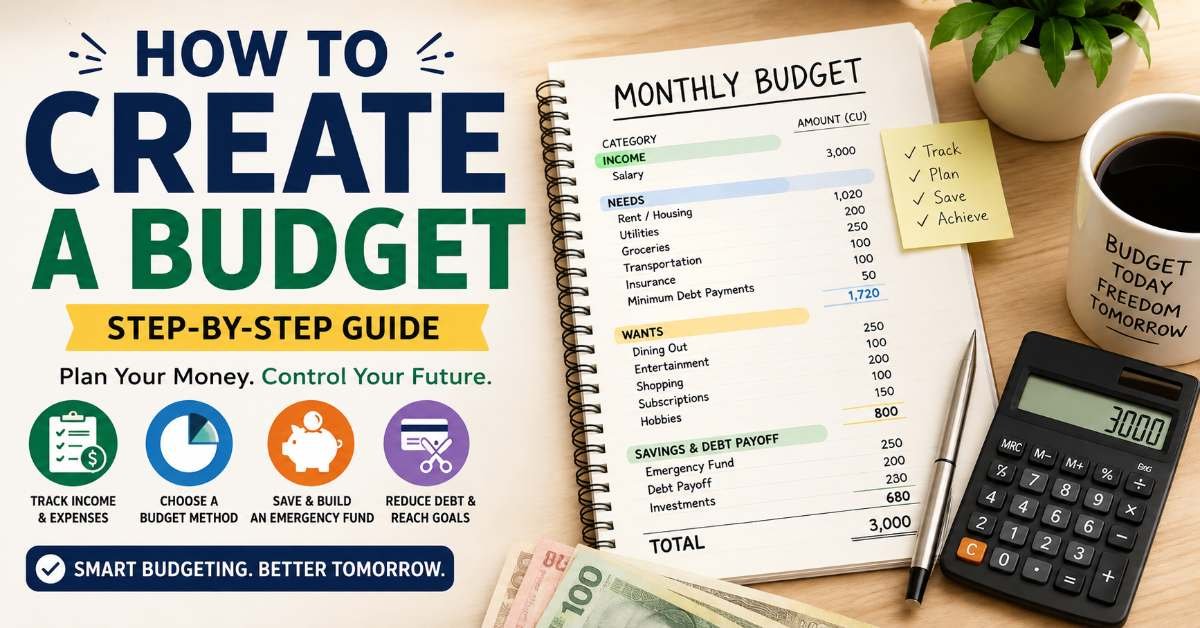
Below is a practical example of a balanced monthly budget using a net monthly income of 3,000 currency units using the 50/30/20 rule:
Monthly Net Income: 3,000.00
Category 1: Needs (50% = 1,500.00 Max)
- Rent / Housing: 900.00
- Utilities (Water, Electricity, Heating, Basic Internet): 200.00
- Core Groceries: 250.00
- Basic Public Transit / Commuter Costs: 100.00
- Minimum Debt Payments: 50.00
- Total Needs Spending: 1,500.00
What Is Copyright 2026? Complete Guide to Copyright Protection & Online Rights
Category 2: Wants (30% = 900.00 Max)
- Dining Out and Cafes: 250.00
- Entertainment, Streaming & Digital Media: 100.00
- Hobbies, Fitness & Personal Care: 150.00
- Shopping, Wardrobe & Casual Leisure: 200.00
- Weekend Activities & Miscellaneous Fun: 200.00
- Total Wants Spending: 900.00
Category 3: Savings & Debt Payoff (20% = 600.00 Target)
- Emergency Fund Deposit: 250.00
- Accelerated Debt Principal Paydown: 200.00
- Long-Term Investment / Retirement: 150.00
- Total Savings and Debt Allocation: 600.00
Final Balance Check:
- Income (3,000.00) – Needs (1,500.00) – Wants (900.00) – Savings (600.00) = 0.00 (Perfect Zero-Based Balance)
9. Monthly Maintenance: The 15-Minute Weekly & Monthly Review
Budgeting is an ongoing practice, not a one-time project. Keep your budget fresh and functional with this simple review routine:
The Weekly 5-Minute Check-in:
- Verify that all recent transactions match your ledger or app.
- Check remaining balances in variable categories (e.g., dining and grocery funds) to adjust spending pacing for the rest of the week.
The Monthly 15-Minute Reset (Last Day of the Month):
- Compare your actual spending against your projected targets.
- Identify which categories had a surplus and which were overspent.
- Check for upcoming irregular bills due in the next 30 days (birthdays, insurance renewals, travel).
- Set up the next month’s budget sheet using the lessons learned from the current month.
10. Frequently Asked Questions (FAQs)
How do I budget if my income is irregular or unpredictable?
Base your baseline living expenses (housing, utilities, basic food) on your lowest-earning month from the prior year. When you have a high-earning month, keep your living expenses unchanged and send the extra earnings directly into an income buffer account or emergency fund. During lean months, draw from this buffer to meet your fixed baseline needs.
What Is Health Insurance? Types, Coverage, Costs & Benefits Explained
How long does it take for a new budget to feel natural?
It typically takes roughly 90 days (three full monthly cycles) for a new budgeting habit to feel seamless. The first month will reveal forgotten expenses, the second month allows you to make corrections, and by the third month, your tracking and spending awareness will feel like second nature.
What should I do if my essential expenses exceed 50% of my income?
In high-cost-of-living areas, housing and essentials frequently consume 60% to 70% of take-home pay. If this applies to you, adapt the framework to a 70/20/10 structure (70% Needs, 20% Savings/Debt, 10% Wants). Focus your energy on two long-term levers: reducing your largest fixed costs (such as finding a roommate or renegotiating utility and insurance plans) and growing your top-line income through career upskilling, promotions, or side projects.
Conclusion: Start Your Financial Transformation Today
Understanding how to create a budget is the single highest-leverage financial habit you can develop. It does not require advanced mathematical skills or extreme frugality. It simply requires an honest look at your current numbers, an intentional choice of budgeting methodology, and a few minutes of weekly maintenance.
Do not wait for the start of a new year or a new month. Pull up your recent bank statements today, calculate your true take-home pay, choose your preferred budgeting method, and assign every dollar a clear mission. Your future financial freedom starts with the very next choice you make.








1 thought on “How to Create a Budget: 10 Simple Steps to Take Control of Your Money”
Comments are closed.