
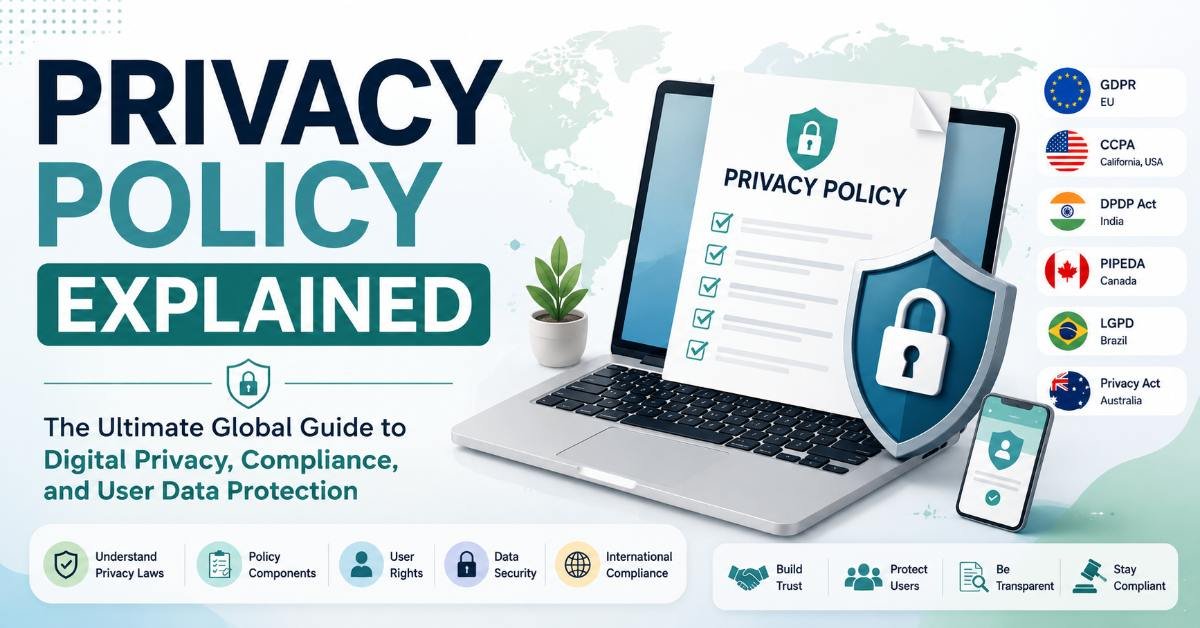
In an era where personal information is traded like digital currency, data privacy is no longer a luxury reserved for legal specialists or corporate boardrooms. It is a fundamental operational necessity for businesses and an essential civil right for internet users. Whether you operate a single-author blog, an international e-commerce store, a software-as-a-service platform, or a multi-tiered mobile ecosystem, your digital presence requires a robust, transparent, and legally sound privacy declaration.
This comprehensive guide delivers a complete, non-technical, and actionable breakdown of the topic: Privacy Policy Explained. Readers will explore the anatomy of privacy disclosures, trace global compliance obligations across major jurisdictions, review step-by-step implementation practices, and learn how to audit digital platforms for hidden data leaks.
What Is a Privacy Policy?
A privacy policy is a legally binding public declaration published on a website, mobile application, desktop software, or connected digital platform. It details exactly how an organization collects, manages, uses, processes, stores, shares, and protects the personal information of its visitors, customers, and registered users.

Beyond fulfilling a basic statutory mandate, a clear privacy policy establishes the foundation of digital trust between a service provider and its audience. It informs visitors about the scope of data capture, outlines their legal rights over their own digital footprint, and sets clear, enforceable boundaries regarding third-party data distribution, tracking technologies, cross-border transfers, and security standards.
Defining Personal Data and Personally Identifiable Information
To understand how privacy disclosures function, one must first recognize what constitutes regulated information. International legal frameworks categorize user information into two primary layers:
- Direct Identifiers: Information that explicitly reveals an individual’s identity without requiring supplementary records. Examples include full legal names, physical residential addresses, personal email addresses, national identity numbers, passport records, telephone numbers, and financial account details.
- Indirect and Technical Identifiers: Data points that may not identify a person on their own, but can easily be combined with other available data sets to isolate an individual. Examples include Internet Protocol (IP) addresses, unique mobile advertising identifiers (such as Apple IDFA or Google AAID), browser fingerprints, browser cookie payloads, precise geographic coordinates, biometric templates, and telemetry logs.
Why Every Online Platform Requires a Dedicated Privacy Policy
Many website administrators believe that a privacy policy is only necessary if their platform processes direct credit card transactions or requires formal user registration. This assumption is legally incorrect. In modern web architectures, almost every functional site handles user data in some capacity.

1. Mandatory Compliance with Global Privacy Laws
Global privacy legislation does not look at where an organization is headquartered; it applies based on where the platform’s end users reside. If a business based in Asia serves website visitors located in North America or Europe, that business must comply with local statutory frameworks such as the European Data Protection Board (EDPB) guidelines. Operating without an updated, accessible policy exposes site owners to regulatory audits, formal compliance warnings, and substantial financial penalties.
2. Mandatory Platform and Third-Party API Terms
Modern websites and applications rely heavily on external software ecosystems to handle analytics, process digital payments, serve display advertising, and maintain infrastructure. Major global service providers strictly require publishers to maintain and display an active, legally compliant privacy policy as a non-negotiable condition of service:
- Web Analytics Platforms: Platforms like Google Analytics and Matomo explicitly require operators to disclose the deployment of analytics cookies, tracking beacons, and data processing routines.
- Ad Networks: Platforms including Google AdSense and programmatic ad exchanges mandate public disclosures concerning interest-based advertising, retargeting pixels, and audience segmentation.
- Payment Gateways: Merchant processors such as Stripe and PayPal demand verifiable privacy disclosures covering transaction security, payment metadata, and customer verification details.
- Mobile App Stores: The Apple App Store and Google Play Console block application submissions and updates if developers fail to provide an accessible, valid privacy policy link covering all in-app permissions and SDK behaviors.
3. Search Engine Optimization and Digital Credibility
Search engines prioritize web properties that exhibit high levels of Experience, Expertise, Authoritativeness, and Trustworthiness (E-E-A-T), as highlighted in Google’s Search Central Documentation. Search indexing crawlers evaluate technical quality and structural legitimacy by verifying standard trust signals across public domains. A missing, hidden, broken, or plagiarized privacy document signals an untrustworthy site, which can harm organic search performance and merchant verification across advertising networks.

4. Consumer Trust and Friction Reduction
Modern consumers are increasingly conscious of digital surveillance, data mining, and platform vulnerabilities. Transparent, accessible explanations of data handling practices reduce friction during user onboarding, increase shopping cart checkout conversions, and build lasting platform loyalty.
Core Components of an Airtight Privacy Policy
A compliant privacy document must avoid vague legal jargon. Global regulators demand plain, transparent language organized into clear operational sections. A thorough privacy policy must include the following structural components:
Section 1: Identification of the Data Controller
The document must clearly state the legal identity of the entity collecting and managing the data. This includes the registered corporate name, trading name, primary physical address, jurisdiction of incorporation, and direct contact details (such as a designated privacy email address).
Section 2: Precise Categories of Data Collected
Organizations must provide an itemized, comprehensive inventory of all data collection points, divided into specific streams:
- Data Provided Voluntarily: Names, shipping details, billing records, email addresses submitted via contact forms, survey submissions, and account credentials.
- Data Collected Automatically: Device profiles, operating system specifications, browser builds, referrer URLs, pages visited, session duration, clickstream paths, and network IP addresses.
- Data Acquired from Third Parties: Credit reference records, demographic data from marketing aggregators, and social login metadata (such as authentication tokens received when signing in via external identity providers).
Section 3: Legal Bases and Purposes for Data Processing
Under global frameworks, platforms must explicitly state the lawful rationale behind every data processing activity. Typical justifications include:
- Contractual Necessity: Processing details to deliver an ordered physical product, maintain an active software subscription, or complete a digital transaction.
- Legitimate Business Interests: Monitoring platform performance, preventing distributed denial-of-service (DDoS) attacks, detecting unauthorized logins, and optimizing site architecture.
- Legal Obligation: Retaining tax invoices, fulfilling statutory financial auditing rules, and complying with court-ordered disclosures.
- Explicit User Consent: Delivering promotional newsletters, running retargeted digital advertisements, or capturing sensitive biometric credentials.
What Is a Savings Account? Types, Benefits, Interest & Fees
Section 4: Third-Party Disclosures and Commercial Transfers
The policy must document all external categories of recipients who receive, process, or view user records. This includes:
- Cloud hosting and server infrastructure providers.
- Customer relationship management (CRM) and automated email platforms.
- Specialized fraud prevention and identity verification services.
- Integrated social media widgets, live-chat scripts, and customer service ticketing tools.
- Prospective corporate buyers or merger partners in the event of a commercial asset sale or acquisition.
Section 5: International Data Transfers
When user information is transferred across international borders, the document must explain the specific transfer safeguards applied, such as the Standard Contractual Clauses (SCCs) approved by the European Commission, adequacy decisions, or binding corporate rules.
How Personal Loans Work: Interest, EMI, Fees & Repayment Guide
Section 6: Data Retention Schedules and Deletion Standards
Organizations cannot hold user data indefinitely without justification. The privacy policy must outline clear retention periods or define the criteria used to determine when records are deleted, anonymized, or securely archived.
Section 7: User Rights and Direct Control Mechanisms
Every user must be informed of their specific data rights under relevant regional laws, along with simple instructions on how to exercise them. Common rights include:
- The right to inspect and receive a portable copy of stored personal records.
- The right to correct inaccurate or outdated information.
- The right to request the permanent deletion of personal profiles (the “Right to be Forgotten”).
- The right to object to or restrict specific processing routines.
- The right to withdraw previously granted consent at any time without penalty.
Section 8: Cookie Usage and Tracking Technologies
Platforms must disclose the use of browser cookies, web beacons, local storage scripts, and tracking pixels. The document should explain:
- The operational differences between essential technical cookies, performance tracking cookies, and behavioral marketing cookies.
- How users can adjust their preferences using an on-site consent manager or their local web browser settings.
Section 9: Protection of Minors
Under child protection laws such as the US Federal Trade Commission COPPA Rule, sites that cater to or inadvertently collect information from minors must state their age thresholds and explain the parental verification controls they use.
Section 10: Security Architecture
While revealing specific network configurations poses a security risk, platforms must provide a high-level overview of their technical and administrative safeguards. This includes mention of TLS/SSL encryption protocols, tokenization, strict access controls, and vulnerability scanning.
Section 11: Notification Procedures for Policy Revisions
The policy must indicate the date it was last revised and explain how users will be alerted to material changes—whether through prominent on-site banners, account dashboards, or direct email alerts.
What Is Investing? A Complete Guide to Building Wealth in 2026
Global Privacy Regulations: A Comparative Legal Breakdown
Understanding international privacy compliance requires a working knowledge of major regional frameworks. Organizations serving a global audience must design their data operations to meet the strictest applicable standards across these jurisdictions.
Major Global Privacy Frameworks at a Glance:
- GDPR (European Union & EEA): Focuses on opt-in strict consent prior to data processing. Non-compliance carries penalties of up to €20 million or 4% of global annual turnover, enforced under the EUR-Lex GDPR Legal Text.
- CCPA / CPRA (California, USA): Operates on an opt-out model featuring mandatory “Do Not Sell or Share My Information” mechanisms. Non-compliance carries civil penalties up to $7,500 per intentional violation, regulated by the California Privacy Protection Agency (CPPA).
- DPDP Act (India): Mandates plain language consent, dedicated consent managers, and clear data protection safeguards, with penalties up to ₹250 Crore per significant breach, as established by the Ministry of Electronics and Information Technology (MeitY).
- PIPEDA (Canada): Requires meaningful consent and limits commercial data capture to reasonable purposes, overseen by the Office of the Privacy Commissioner of Canada (OPC).
- LGPD (Brazil): Features a 10-point legal base system closely parallel to European GDPR architecture, carrying fines up to 2% of annual revenue per infraction, regulated by the Autoridade Nacional de Proteção de Dados (ANPD).
- Privacy Act 1988 (Australia): Enforces 13 Australian Privacy Principles (APPs) with strict cross-border disclosure rules, overseen by the Office of the Australian Information Commissioner (OAIC).
1. The European Union: General Data Protection Regulation (GDPR)
Enacted in May 2018, the European Union’s General Data Protection Regulation represents the global benchmark for digital privacy protection. The GDPR applies to any organization worldwide that processes the personal data of individuals located within the European Economic Area (EEA), regardless of the business’s physical location.
- Core Operational Principle: Strict Opt-In Consent. Non-essential tracking mechanisms (including marketing cookies and behavioral profiling tools) cannot execute until the user grants unambiguous, freely given, and documented consent.
- Extraterritorial Scope: Enforceable against any website or web application offering goods, services, or tracking behavior within the EU.
- User Rights: Comprehensive provisions covering the right of access, rectification, data portability, immediate objection, and permanent erasure.
- Data Breach Protocols: Mandatory notification to the relevant Supervisory Authority within 72 hours of identifying a security incident involving personal data.
- Statutory Penalties: Fines can reach up to 20 million euros or four percent of the company’s total worldwide annual turnover from the preceding financial year, whichever is higher.
2. The United States: California Consumer Privacy Act and CPRA
The United States does not have a single comprehensive federal privacy law covering all commercial data. Instead, privacy protections are governed by a patchwork of sector-specific federal statutes (such as HIPAA for healthcare and GLBA for financial institutions) and comprehensive state-level privacy acts. The most influential state framework is the California Consumer Privacy Act (CCPA), as amended by the California Privacy Rights Act (CPRA).
- Core Operational Principle: Notice and Opt-Out. Unlike the European model, websites may generally collect data by default, provided they present clear upfront notice and offer an easy opt-out mechanism.
- Mandatory Website Links: Platforms subject to the CCPA/CPRA must display a clear, permanent link on their homepage and footer titled: “Do Not Sell or Share My Personal Information.”
- Sensitive Personal Information: Consumers have the specific legal right to limit an organization’s use of sensitive data points, such as precise geolocation, racial origin, religious beliefs, private communications, and health data.
- Enforcement: Enforced directly by the California Privacy Protection Agency, with civil penalties of up to $7,500 per intentional violation, alongside a private right of action for data breaches resulting from poor security practices.
- Other State Laws: Businesses must also track emerging, comprehensive privacy statutes across Virginia (VCDPA), Colorado (CPA), Connecticut (CTDPA), Texas (TDPSA), and Utah (UCPA).
3. India: Digital Personal Data Protection Act (DPDP Act)
India’s Digital Personal Data Protection Act establishes a modern data governance framework for one of the world’s largest internet user bases.
- Core Operational Principle: Clear Consent and Specified Legitimate Uses. Data fiduciaries (entities determining the purpose of data processing) must provide an easily understood notice outlining the categories of data collected and the precise purpose of processing.
- Language and Accessibility: The notice must be presented in clear, accessible language, with options to review the text in English or any of the 22 languages listed in the Eighth Schedule to the Constitution of India.
- Consent Architecture: Users retain the explicit right to withdraw consent through accessible digital consent managers.
- Processing Involving Children: Imposes strict bans on behavioral tracking, targeted advertisements, and automated processing that could negatively affect minors, requiring verifiable parental consent.
- Statutory Penalties: Financial penalties can reach up to 250 crore rupees for severe data breaches or systematic failure to implement adequate security safeguards.
4. Canada: Personal Information Protection and Electronic Documents Act (PIPEDA)
Canada’s federal privacy law, PIPEDA, governs how private-sector organizations handle personal information during commercial activities.
- Core Operational Principle: Meaningful Consent. Organizations must ensure that individuals clearly understand the nature, purpose, and consequences of the personal information they share.
- Reasonableness Standard: Data can only be collected, used, or disclosed for purposes that a reasonable person would consider appropriate under the circumstances.
- Data Access and Correction: Individuals have the right to challenge the accuracy and completeness of their personal records and have them amended as necessary.
5. Other Important Global Frameworks
- Brazil (LGPD – Lei Geral de Proteção de Dados): Closely mirrors the structure of the European GDPR, establishing ten legal bases for processing, creating user rights, and setting up the National Data Protection Authority (ANPD) to enforce penalties.
- Australia (Privacy Act 1988): Governs data handling through thirteen Australian Privacy Principles (APPs), requiring entities to maintain clear, accessible policies that explain overseas disclosures and detail how individuals can file formal privacy complaints.
Technical Auditing: Identifying Hidden Data Collection on Your Platform
Writing an accurate privacy policy requires a full, precise inventory of the data your digital platforms collect. Many administrators publish generic policy documents, unaware that their site’s underlying technical infrastructure silently leaks personal information.
Follow this technical auditing procedure to identify all hidden data collection points across your web property:
1. Perform a Comprehensive Browser Developer Audit
Open your website using your browser’s Developer Tools (F12 or Inspect Mode) in a clean, private browsing window:
- Navigate to the Application or Storage tab. Inspect the Cookies, Local Storage, and Session Storage menus. Document every active cookie name, its originating domain, its expiration window, and its functional purpose.
- Open the Network tab, check the “Preserve Log” option, and refresh the webpage. Filter requests by “Fetch/XHR” and “JS”. Look for external network calls pinging third-party endpoints. Common calls include tag management systems, pixel trackers, heatmapping scripts, and font libraries.
2. Audit Embedded Scripts and Third-Party Dependencies
Review your source code and tag manager containers for tracking elements that operate in the background:
- Embedded Content: Embedded YouTube videos, Vimeo players, and interactive map widgets set tracking cookies and record visitor IP addresses as soon as the host page loads.
- Social Media Plugins: Native “Share” or “Like” buttons transmit behavioral analytics back to their parent social networks, even if the visitor never clicks the button.
- Content Delivery Networks (CDNs) and Web Fonts: External script and font dependencies hosted on shared third-party networks capture user IP addresses and browser configurations during standard asset downloads.
3. Review Web Server Access and Security Logs
Web hosting servers automatically record raw access logs to maintain network stability and defend against attacks. These logs capture raw visitor IP addresses, timestamps, HTTP request paths, HTTP status codes, and browser user-agent strings. Your privacy policy must disclose the collection of these server logs, along with their retention windows and security purposes.
4. Trace Contact Forms, Lead Funnels, and Database Storage
Review all input fields across your contact pages, lead generation forms, and user registration flows. Confirm where that form data goes once submitted:
- Is it written to an internal database?
- Is it transmitted through an external transactional email relay?
- Is it automatically forwarded to a CRM platform?
- Are backup archives created, and where are those backups stored?
Every intermediary service provider involved in these data flows must be accounted for in your public policy disclosures.
Step-by-Step Implementation: Creating and Deploying a Compliant Privacy Policy
Drafting and deploying a robust privacy policy involves a structured, repeatable process. Follow these core steps to ensure complete coverage:
The Implementation Sequence:
- Step 1: Technical & Vendor Discovery: Audit all forms, server logs, analytics tags, and third-party SDKs across your web ecosystem.
- Step 2: Map Data Processing Paths: Match each collected data point to a lawful business basis, such as contractual necessity or consent.
- Step 3: Draft Clear Policy Sections: Write transparent, plain-English disclosures without relying on ambiguous legal catch-alls.
- Step 4: Optimize Site Placement: Add direct links in the global footer, on all input forms, and within checkout menus.
- Step 5: Sync with Consent Banners: Ensure your cookie consent management platform actively blocks trackers until users opt in.
- Step 6: Schedule Annual Policy Audits: Review, re-scan, and update your published privacy documentation at least once every 12 months.
Step 1: Complete a Data Flow Mapping Exercise
Document every piece of user information that enters your digital ecosystem. Group your findings into three distinct columns:
- Data Type: Email address, payment card token, visitor IP, device browser profile, or shipping address.
- Collection Mechanism: Contact form submission, checkout funnel, newsletter popup, server access log, or analytics script.
- External Destination: Cloud hosting infrastructure, email marketing software, payment processor, or analytics dashboard.
Step 2: Establish a Lawful Basis for Each Data Category
Review your mapped data flows and assign a clear legal justification to every collection stream. If you cannot identify a legitimate operational need, a legal obligation, a contractual requirement, or explicit user consent for a particular data field, remove that field from your forms immediately. Collecting data “just in case it might be useful later” violates modern data minimization principles under international law.
Step 3: Draft Clear, Accessible Policy Text
Draft each policy section using direct, plain language. Structure the content with clear descriptive titles, short paragraphs, and clean bulleted lists to make the document easy to scan. Avoid ambiguous legal catch-alls such as: “We may collect your information to enhance our business operations and share it with select partners for marketing purposes.”
Instead, provide specific and transparent explanations: “We collect your email address when you subscribe to our newsletter. We use this address exclusively to deliver our weekly industry roundups through our automated email provider. We do not sell, rent, or trade your email address with third-party advertisers.”
Step 4: Ensure High-Visibility Placement Across All Platforms
A privacy policy must be easily accessible from anywhere on your platform. To maintain compliance, place direct, persistent links in the following locations:
- Site-Wide Global Footer: Add a clear, permanent “Privacy Policy” link in your global website footer so it appears on every page.
- Interactive Form Locations: Add a direct link and an unticked consent checkbox immediately below lead capture forms, contact pages, and comment submission areas.
- Checkout and Account Creation Pages: Display explicit policy notices and consent confirmations right before users submit payment details or create new platform accounts.
- Navigation Menus in Mobile Apps: In native mobile apps, place a dedicated privacy policy link inside the primary settings menu or account profile screen.
- Store Listing Metadata: Add your live privacy policy URL directly to your public app store listing pages within the Apple App Store and Google Play Console.
Step 5: Integrate Policy Terms with Your Consent Management Platform (CMP)
A written policy must match your site’s actual technical behavior. If your document states that users have control over tracking cookies, your platform must actively support that choice through a properly configured Consent Management Platform (CMP):
- Ensure that all non-essential analytics, marketing, and third-party tracking scripts are blocked by default.
- Fire these scripts only after the visitor grants explicit permission through your cookie consent interface.
- Give users a persistent, accessible way to reopen the consent manager and update their preferences at any time during their visit.
Step 6: Establish an Annual Review and Update Schedule
Digital privacy is not a static, one-time project. New regulations are introduced regularly, third-party software vendors frequently update their tracking methods, and your own platform will evolve over time as you introduce new features.
Establish an annual review schedule to re-audit your site’s technical scripts, check your data flows, verify your vendor list, and update your published privacy documentation accordingly.
Critical Privacy Policy Mistakes to Avoid
Even experienced developers and organizations often make critical privacy errors that undermine their legal protections and damage user trust. Avoid these common mistakes:
1. Copying and Pasting Competitor Policies
Copying a privacy policy from another company creates significant legal and operational risks. Your competitor may use entirely different third-party vendors, store data in different geographic regions, handle different categories of user information, or simply rely on an outdated, legally invalid document. Copying their text can leave your actual data practices unprotected, and it may also constitute copyright infringement.
2. Disconnecting Policy Text from Actual Technical Behavior
A privacy policy must accurately reflect the real-world technical configuration of your site. If your policy claims that your platform does not use tracking cookies, but an automated compliance scan detects active tracking pixels firing on page load, your organization can be held liable for deceptive trade practices.
3. Relying on Dark Patterns to Collect Consent
Dark patterns are manipulative user-interface designs engineered to trick visitors into giving up their privacy rights. Common examples include:
- Designing cookie banners with high-contrast, prominent “Accept All” buttons placed next to tiny, faded, low-contrast “Reject” links.
- Pre-ticking consent checkboxes across checkout flows and newsletter subscription forms.
- Making it easy for users to opt in to tracking while requiring complicated, multi-step email requests to opt back out.
International regulatory bodies actively penalize platforms that employ deceptive user-interface designs to force consent.
4. Using Broken, Hidden, or Obscured Links
Hiding a privacy policy link inside a complex sub-menu, using tiny, unreadable fonts, or allowing policy URLs to resolve in 404 errors violates international transparency mandates. Regulators require privacy disclosures to be direct, prominent, and easily accessible to all users.
5. Ignoring Changes in Underlying Vendor SDKs and Scripts
When you install a third-party plugin, analytics script, or monetization SDK, that software may update its own data collection practices over time. If a vendor introduces new tracking capabilities without your knowledge and your public policy fails to disclose them, your platform remains directly accountable for the resulting unauthorized data processing.
Complete, Production-Ready Privacy Policy Template
Below is a complete, modular, and customizable privacy policy template designed for modern websites, web applications, and global online businesses.
To adapt this template for your platform, replace every capitalized placeholder inside the square brackets (such as [ORGANIZATION NAME], [EMAIL ADDRESS], and [PHYSICAL ADDRESS]) with your organization’s specific operational details.
PRIVACY POLICY
Last Updated: [INSERT DATE, E.G., AUGUST 21, 2026] Effective Date: [INSERT EFFECTIVE DATE]
1. Overview and Scope
This Privacy Policy explains how [INSERT ORGANIZATION OR WEBSITE NAME] (“we,” “our,” or “us”) collects, uses, processes, stores, shares, and protects your personal information when you access or use our website located at [INSERT WEBSITE URL], our mobile applications, and our associated digital products and services (collectively, the “Services”).
We are committed to handling personal data responsibly, transparently, and in full accordance with applicable international privacy frameworks, including the European Union General Data Protection Regulation (GDPR), the California Consumer Privacy Act as amended by the California Privacy Rights Act (CCPA/CPRA), the Indian Digital Personal Data Protection Act (DPDP Act), the Canadian Personal Information Protection and Electronic Documents Act (PIPEDA), and other applicable regional data protection laws.
Please read this policy carefully. If you do not agree with our data practices as described, please discontinue your use of our Services immediately.
2. Identity of the Data Controller
For the purposes of applicable data protection legislation, the entity responsible for determining the purposes and means of processing your personal data (the Data Controller) is:
- Legal Entity Name:
[INSERT FULL LEGAL ENTITY / COMPANY NAME] - Registration / Incorporation Number:
[INSERT REGISTRATION NUMBER] - Physical Business Address:
[INSERT REGISTERED PHYSICAL POSTAL ADDRESS] - Jurisdiction of Incorporation:
[INSERT COUNTRY / STATE OF INCORPORATION] - Designated Privacy Officer / Contact Email:
[INSERT DEDICATED PRIVACY EMAIL ADDRESS]
3. Categories of Information We Collect
We collect information across three distinct channels: data you provide directly, data gathered automatically through technical interactions, and data received from external third-party sources.
A. Information You Provide Directly to Us
- Contact Details: Name, personal or business email address, physical postal address, and telephone number when you submit forms, sign up for newsletters, or reach out to our support team.
- Account Credentials: Username, password hash, profile details, and account preferences when you register on our platform.
- Billing and Payment Information: Payment card tokens, billing addresses, tax identifiers, and transaction records collected to complete purchases. (Note: Raw payment card numbers are processed directly by our PCI-DSS-compliant payment processors and are never stored on our local servers).
- User-Generated Submissions: Comments, product reviews, feedback responses, customer support messages, and survey entries.
B. Information Collected Automatically
- Device and Browser Identifiers: Network IP address, browser type and version, language settings, operating system specifications, device manufacturer, and screen resolution.
- Usage and Telemetry Data: Referrer URLs, pages visited, links clicked, time spent on individual pages, access timestamps, bounce rates, and navigation clickstream paths.
- Location Records: General geographic location derived from network IP addresses (city and country level). We do not collect precise real-time satellite GPS coordinates without your explicit, opt-in consent.
- Cookies and Tracking Technologies: Data collected via browser cookies, local web storage, tracking pixels, and server logs.
C. Information Received from Third Parties
- Authentication Providers: Profile information (such as name and email address) received when you choose to register or log in using third-party services.
- Service Partners: Fraud prevention indicators, identity verification records, and technical delivery confirmations from our infrastructure partners.
4. Lawful Bases and Purposes for Processing Personal Data
We process personal data only when we have a clear legal justification to do so. These lawful bases and operational purposes include:
- Performance of a Contract: To create and manage your user account, deliver purchased products or services, handle billing transactions, and provide customer support.
- Legitimate Business Interests: To monitor, maintain, and optimize platform performance; protect against fraud, malicious activity, and unauthorized access; understand user interactions to improve our content; and ensure overall network stability.
- Compliance with Legal Obligations: To maintain financial and tax records, satisfy commercial auditing requirements, prevent fraud, and comply with lawful requests from public authorities.
- With Your Explicit Consent: To send direct promotional email marketing, deliver targeted digital advertisements, and deploy non-essential tracking cookies. You may withdraw this consent at any time.
5. Sharing and Disclosure of Personal Information
We do not sell, rent, or trade your personal information to third-party data brokers. We share personal data only with trusted third parties under strict confidentiality and security terms:
- Hosting and Infrastructure Providers: Cloud hosting networks, database management services, and backup providers that keep our platforms running securely.
- Payment Processors: Regulated financial gateways that securely process transactions and prevent payment fraud.
- Communication and Email Vendors: Automated messaging platforms used to deliver transactional receipts, service updates, and marketing communications.
- Analytics and Performance Partners: Measurement platforms that help us analyze site traffic and improve performance.
- Corporate Restructuring and Business Transfers: Prospective buyers, investors, or advisors in the event of a business merger, asset sale, acquisition, or restructuring.
- Legal and Regulatory Compliance: Law enforcement agencies, regulators, courts, or legal counsel when required by law, subpoena, or valid legal process.
6. International Data Transfers
Your information may be transferred to, stored on, and processed by servers located outside your country of residence, where data protection laws may differ from those in your home jurisdiction.
Whenever we transfer personal information across international borders, we implement appropriate legal safeguards to protect your records. These safeguards include relying on European Commission Adequacy Decisions, executing standard contractual clauses (SCCs), and enforcing strict data processing agreements with our global vendors.
7. Data Retention Schedules
We keep your personal information only for as long as necessary to fulfill the purposes outlined in this Privacy Policy, unless a longer retention period is required or permitted by law.
- Account Data: Retained for the duration of your active account lifecycle. If you choose to close your account, your data will be deleted or anonymized within
[INSERT TIMEFRAME, E.G., 30 DAYS], unless needed to resolve disputes or meet legal obligations. - Transaction Records: Retained for
[INSERT NUMBER, E.G., 7 YEARS]to comply with applicable tax, corporate accounting, and financial reporting laws. - Server Access Logs: Retained for a rolling window of
[INSERT NUMBER, E.G., 90 DAYS]for cybersecurity monitoring and threat analysis, after which they are permanently overwritten.
8. Cookies and Web Tracking Technologies
We use browser cookies, web beacons, and local storage mechanisms to recognize your browser, remember preferences, maintain secure active sessions, and analyze traffic patterns.
- Strictly Necessary Cookies: Essential technical cookies required for platform operation, secure authentication, and shopping cart persistence. These cannot be disabled through our consent manager.
- Performance and Analytics Cookies: Help us gather aggregate data regarding visitor traffic volume, popular pages, and performance bottlenecks.
- Functional Cookies: Remember user preferences, such as selected language and UI display themes.
- Targeting and Advertising Cookies: Placed by trusted advertising partners to build interest profiles and serve relevant advertisements across external websites.
You can manage your cookie preferences at any time using our on-site cookie settings or through your local browser configuration.
9. Your Legal Rights Regarding Your Personal Data
Depending on your physical location and the privacy laws applicable in your jurisdiction, you may hold specific legal rights concerning your personal information:
- Right of Access: You have the right to request confirmation of whether we process your data, along with a portable copy of your stored records.
- Right to Rectification: You have the right to request the immediate correction of inaccurate or incomplete personal records.
- Right to Erasure (The Right to be Forgotten): You have the right to request the permanent deletion of your personal records when they are no longer needed for their original processing purposes.
- Right to Restrict or Object to Processing: You have the right to object to our reliance on legitimate interests or request limits on how your data is processed.
- Right to Data Portability: You have the right to receive your personal data in a structured, commonly used, and machine-readable format.
- Right to Withdraw Consent: Where data processing is based on consent, you may withdraw that consent at any time without affecting the lawfulness of processing carried out prior to withdrawal.
- Right to Non-Discrimination: We will never deny services, charge different prices, or provide a lower quality of service if you choose to exercise any of your privacy rights.
To exercise any of these rights, please submit a formal request to our designated privacy team at [INSERT DEDICATED PRIVACY EMAIL ADDRESS]. We will review and respond to verified requests within [INSERT TIMEFRAME, E.G., 30 CALENDAR DAYS].
10. California Privacy Disclosures (CCPA / CPRA Notice)
This section applies exclusively to residents of the State of California:
- Notice of Collection: Over the preceding 12 months, we have collected the categories of personal information listed in Section 3 of this document.
- Sale and Sharing of Data: We do not sell personal information for direct monetary compensation. We do not share personal records for cross-context behavioral advertising without explicit opt-out opportunities.
- Do Not Sell or Share My Information: California residents may opt out of data sharing by clicking the “Do Not Sell or Share My Personal Information” link located in our website footer or by submitting a request to
[INSERT PRIVACY EMAIL ADDRESS]. - Limiting Sensitive Information: We do not use or disclose sensitive personal information for purposes other than providing our core services.
11. Information Security Protocols
We maintain appropriate technical, organizational, and physical security safeguards designed to protect personal data against accidental loss, unauthorized access, destructive alteration, and unlawful disclosure. These measures include TLS/SSL encryption for data in transit, secure database hashing, multi-factor administrative authentication, network firewalls, and regular security reviews.
However, no digital transmission channel or electronic storage architecture is completely immune to security threats. While we work diligently to protect your information, we cannot guarantee absolute, foolproof security.
12. Protection of Children’s Privacy
Our Services are not designed for or directed to individuals under the age of [INSERT AGE, E.G., 13 OR 16 YEARS]. We do not knowingly collect, process, or solicit personal information from minors. If we discover that we have inadvertently collected personal data from a child without verifiable parental consent, we will delete that information from our servers immediately.
If you believe that a minor has provided us with personal data, please notify us right away at [INSERT PRIVACY EMAIL ADDRESS].
13. Third-Party External Links
Our Services may contain links to external websites, web services, and third-party tools that are not owned or operated by us. We are not responsible for the content, security practices, or privacy standards of these external platforms. We encourage you to review the privacy policies of any third-party websites you visit.
14. Changes to This Privacy Policy
We may update this Privacy Policy periodically to reflect changes in our technical architecture, business operations, or legal requirements.
When material changes are made, we will notify you by updating the “Last Updated” date at the top of this document, displaying an alert banner on our homepage, or sending a direct notification to your registered account email address. We encourage you to review this policy periodically to stay informed about how we protect your personal data.
15. Contact Information and Dispute Resolution
If you have questions, comments, concerns, or formal complaints regarding this Privacy Policy or our data handling practices, please contact our team using the details below:
- Organization Name:
[INSERT LEGAL COMPANY NAME] - Attention: Data Protection Officer / Privacy Compliance Department
- Mailing Address:
[INSERT FULL PHYSICAL POSTAL ADDRESS] - Email Contact:
[INSERT DEDICATED PRIVACY EMAIL ADDRESS] - Telephone Number:
[INSERT DIRECT TELEPHONE CONTACT]
If you are a resident of the European Economic Area, the United Kingdom, or Switzerland and believe your concerns have not been addressed satisfactorily, you also have the right to lodge a formal complaint with your local data protection supervisory authority.
Technical and Operational Checklist for Ongoing Privacy Maintenance
Deploying a privacy policy is an active, ongoing operational responsibility. Use this maintenance checklist to keep your platform compliant throughout the year:
- Audit Tracking Technologies: Re-scan all website pages for unlisted third-party tracking scripts, cookies, and local storage variables.
- Form Compliance Check: Verify that all web forms include clear privacy policy links and unticked consent checkboxes.
- Consent Manager Verification: Confirm that your consent manager actively blocks marketing cookies until the user clicks accept.
- Channel Testing: Test your privacy contact email address to ensure incoming user inquiries and data requests are received and logged promptly.
- Vendor Contract Review: Check third-party vendor contracts (hosting, CRM, payment processors) for active, updated data processing agreements.
- Data Retention Purging: Review database retention schedules and purge expired, non-essential user records.
- Security Protocol Audits: Verify that SSL/TLS certificates, database hashing, and encryption protocols are properly configured and active.
- Timestamp Updates: Update the “Last Updated” timestamp on your public privacy policy page following every formal review.
Frequently Asked Questions About Privacy Policies
Is a privacy policy legally required for every website?
Yes. If your website collects any form of personal information—even basic data points such as IP addresses via server logs or tracking metrics through tools like Google Analytics—you are legally required to provide a clear, public privacy policy under global laws such as the GDPR, CCPA, and DPDP Act.
Can I copy a privacy policy from another site?
No. Copying a privacy policy from another company is legally risky and ineffective. Every digital platform uses a unique mix of analytics scripts, advertising tags, hosting providers, and operational data paths. Copying another site’s policy leaves your unique data practices uncovered, can lead to regulatory penalties for inaccurate disclosures, and may violate copyright protections.
Where should I place my privacy policy link?
Your privacy policy link must be prominently placed and easily accessible across your platform. Standard best practices include adding a permanent link in your global website footer, placing direct references on all web forms and checkout flows, and including a visible link within your mobile application’s main settings menu.
How often should an organization update its privacy policy?
Organizations should review their privacy policies at least once every 12 months. In addition, an immediate review is recommended whenever you launch new platform features, integrate new third-party analytics or monetization scripts, change your cloud hosting infrastructure, or when new data protection laws take effect in your target markets.
Digital data privacy is now a central pillar of modern web development and online business operations. Maintaining a comprehensive, accurate, and easily understood privacy policy protects your organization against regulatory penalties, builds long-term customer trust, and ensures full compliance across the global digital landscape.
(Disclaimer: This educational guide provides comprehensive structural, operational, and technical analysis regarding digital privacy standards. It does not constitute formal legal advice. For specific regulatory compliance assessments tailored to your exact corporate architecture, consult with a qualified data protection attorney in your operational jurisdiction.)







1 thought on “Privacy Policy Explained 2026: Global Guide to Data Privacy & User Rights”
Comments are closed.