
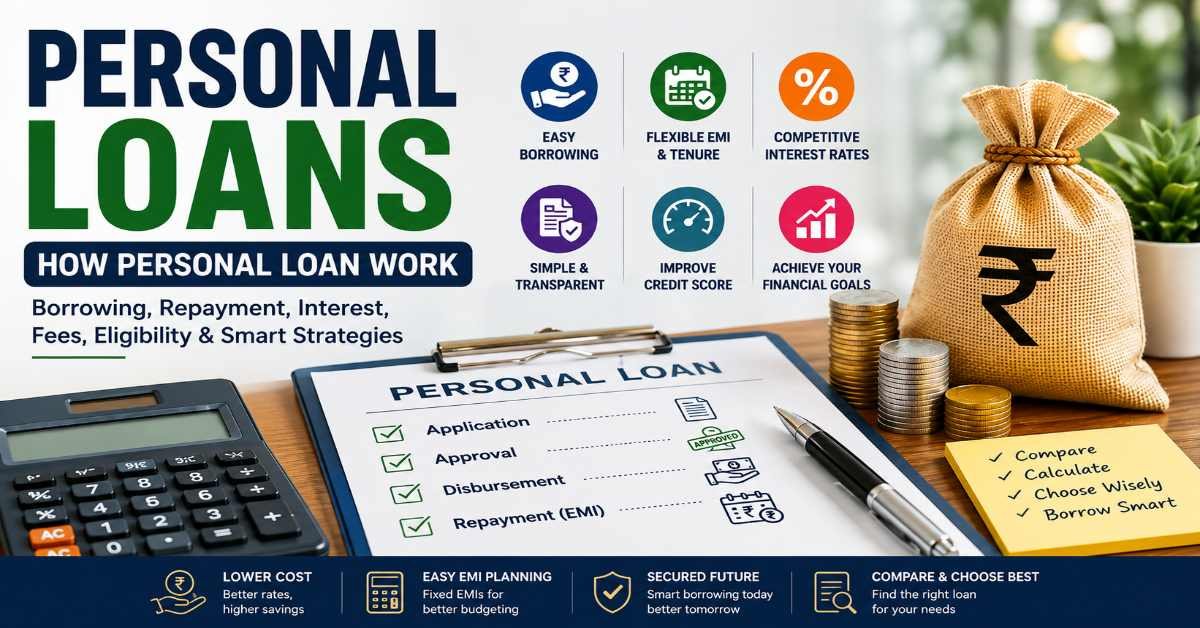
Personal loans are among the most versatile financial tools available in modern personal finance. Whether you need to consolidate high-interest credit card debt, finance a major life event, pay unexpected medical bills, or remodel your home, a personal loan offers structured borrowing with predictable terms.
Unlike dedicated financing options such as mortgages or auto loans, personal loans offer substantial flexibility in how the capital is deployed. Understanding the inner mechanics of personal loans—including approval algorithms, interest computation, repayment structures, and hidden fee architecture—allows borrowers worldwide to make strategic financial decisions and save substantial money over the life of a loan.
How to Create a Budget: 10 Simple Steps to Take Control of Your Money
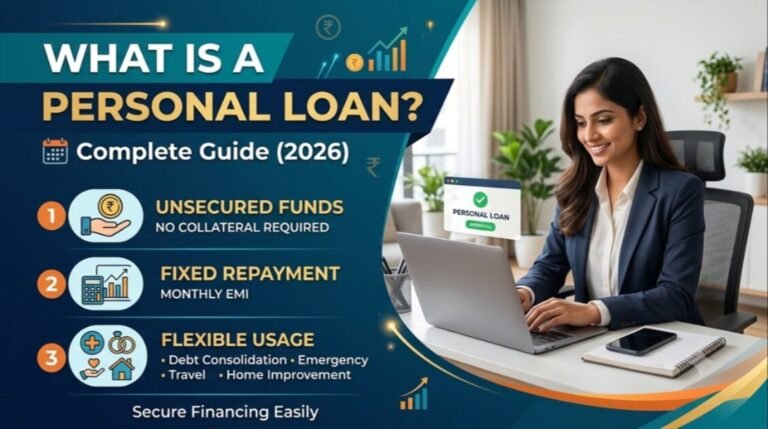
1. What Is a Personal Loan?
A personal loan is a form of installment credit provided by financial institutions, including traditional retail banks, credit unions, and digital non-banking financial companies (NBFCs) or fintech lenders. When you take out a personal loan, the lender disburses a lump sum of money directly into your bank account. In exchange, you commit to repaying the principal balance along with accrued interest and applicable administrative fees over a predefined repayment window.
Personal loans operate on an amortization schedule, which means your debt is divided into equal, regular installments (typically paid monthly). Every monthly installment consists of two components:
- Principal: The direct portion of the payment that reduces your initial borrowed balance.
- Interest: The cost charged by the lender for the service of lending the money.
2. Unsecured vs. Secured Personal Loans
Understanding how personal loans function requires distinguishing between the two primary categories: unsecured and secured loans.
Unsecured Personal Loans (Standard Installment Loans)
The vast majority of consumer personal loans issued worldwide are unsecured.
- No Collateral Required: You are not required to pledge physical assets, such as real estate, vehicles, or investment accounts, to secure the funds.
- Underwriting Reliance: Because the lender assumes greater loss risk if you default, approvals, borrowing limits, and interest rates depend heavily on your creditworthiness, verified income, employment stability, and existing financial obligations.
- Lender Recourse: If a borrower defaults on an unsecured loan, the lender cannot automatically seize property without legal action. However, delinquency severely damages your credit profile, triggers third-party debt collection, and may lead to legal judgments.
Secured Personal Loans
Secured personal loans require the borrower to provide an asset as collateral.
- Pledged Collateral: Lenders accept assets such as fixed deposits, certificates of deposit (CDs), savings balances, vehicles, or precious metals.
- Lower Risk Profile: Because the lender can liquidate the asset in the event of default, secured loans typically feature lower interest rates and more lenient approval criteria.
- Borrower Risk: If you fail to meet your scheduled repayment obligations, the lender retains the legal right to seize the collateral to recover their outstanding capital.
What Is Investing? A Complete Guide to Building Wealth in 2026
3. The Core Mechanics: How Personal Loans Operate Step-by-Step
Understanding the operational life cycle of a personal loan ensures you avoid common administrative and financial pitfalls.
Step 1: Prequalification and Rate Shopping
Most modern financial platforms offer a soft credit check prequalification tool. This mechanism allows you to view estimated borrowing limits, interest rates, and loan terms without impacting your credit score. During prequalification, the lender uses basic financial disclosures to generate a provisional offer.
Step 2: Formal Application and Verification
Once you select an offer, you submit a formal application. This stage triggers a hard credit inquiry (which temporarily lowers your credit score by a few points) and requires comprehensive document verification:
- Proof of Identity (Passport, National ID, Driver’s License)
- Proof of Residence (Utility bills, rental agreements)
- Proof of Income (Recent pay slips, tax filings, or bank statements showing regular cash flow)
Step 3: Underwriting and Risk Assessment
Underwriters—using automated algorithms or manual credit officers—evaluate your debt-to-income ratio (DTI), debt service coverage, credit history length, credit utilization, and repayment consistency. If the calculated risk meets the lender’s threshold, the loan is formally approved.
Step 4: Loan Agreement and Fund Disbursement
Upon signing the credit contract, the lender initiates the disbursement process. Funds are electronically transferred to your verified checking or savings account. Depending on the lender’s technology stack and regional banking clearing systems (such as ACH in the United States, SEPA in Europe, or IMPS/NEFT in India), disbursement can take anywhere from a few minutes to three business days.
Step 5: Amortization and Systematic Repayment
Repayment begins on the agreed-upon date, typically 30 days after disbursement. Monthly payments remain constant if the loan features a fixed interest rate. With each payment, the proportion going toward interest decreases while the amount reducing the principal balance increases.
4. Interest Rates, APR, and the True Cost of Borrowing
When evaluating personal loans, many borrowers make the critical mistake of looking exclusively at the nominal interest rate. To understand the total cost of credit, you must understand the distinction between Interest Rate and Annual Percentage Rate (APR).
Nominal Interest Rate
The nominal interest rate is the base percentage charged on the principal balance. It represents the direct compensation the lender earns for taking on financial risk.
Annual Percentage Rate (APR)
The APR provides an all-inclusive picture of your borrowing costs. It factors in the nominal interest rate along with all mandatory lender fees, such as upfront origination fees, administrative charges, and processing costs.
For an accurate assessment of any loan offer, always evaluate the APR rather than the nominal rate. For global resources on consumer credit protections and understanding credit terminology, visit the Consumer Financial Protection Bureau (CFPB) or international equivalents like the OECD Consumer Protection Division.
Fixed vs. Variable Interest Rates
- Fixed-Rate Loans: The interest rate remains identical across the entire life of the loan. Your monthly payment never fluctuates, providing predictable budgeting.
- Variable-Rate Loans: The interest rate is tethered to an underlying benchmark rate (such as the Secured Overnight Financing Rate or central bank base rates). If benchmark rates climb, your monthly payment or loan duration increases; if rates drop, borrowing costs fall.
What Is Cryptocurrency 2026? How Crypto, Bitcoin & Blockchain Work
5. Typical Personal Loan Fee Structures
Borrowers should carefully review the fine print of their loan agreement for common administrative fees:
- Origination Fees: An administrative charge deducted from the loan balance prior to disbursement, usually ranging from 1% to 10% depending on your credit tier. If you borrow $10,000 with a 5% origination fee, you receive $9,500, but still owe the full $10,000 principal plus interest.
- Prepayment Penalties: Some traditional lenders charge a fee if you pay off the loan early, as early repayment reduces the total interest the lender expects to collect. Leading online lenders generally eliminate prepayment fees.
- Late Payment Fees: Penalties applied when a scheduled installment is not received within the specified grace period.
- Failed Payment (Returned Check/ACH) Fees: Costs incurred when an automated direct debit fails due to non-sufficient funds (NSF).
6. How Loan Amortization Works
Personal loans use a reducing-balance amortization model. Because the interest for any given payment cycle is calculated strictly on the remaining principal balance, early payments contain a higher proportion of interest charges. As the principal drops, subsequent interest calculations produce lower amounts, accelerating principal reduction toward the end of the term.
Amortization Schedule Profile ($10,000 Loan at 10% APR over 36 Months)
- Monthly Payment: Approximately $322.67
- Month 1 Breakdown: ~$83.33 allocated to interest, ~$239.34 allocated to principal reduction.
- Month 18 Breakdown: ~$44.15 allocated to interest, ~$278.52 allocated to principal reduction.
- Month 36 Breakdown: ~$2.67 allocated to interest, ~$320.00 allocated to principal reduction.
- Total Interest Paid Over 3 Years: Approximately $1,616.12.
Choosing a shorter repayment term (e.g., 24 months instead of 60 months) increases your monthly payment but significantly reduces the total interest paid over the life of the debt.
How to Buy a House in 2026: Complete Step-by-Step Guide for First-Time Buyers
7. Major Types and Uses of Personal Loans
Personal loans can be used for a wide range of personal and household needs:
1. High-Interest Debt Consolidation
Consolidation involves using a single, lower-interest personal loan to pay off multiple credit cards or high-cost debts. This strategy consolidates multiple monthly due dates into a single fixed payment and can reduce your overall interest expenses.
2. Home Improvement and Repairs
Homeowners often use unsecured personal loans for renovations, roof repairs, or energy-efficiency upgrades when they want to avoid borrowing against their home equity via a second mortgage or HELOC.
3. Emergency and Medical Expenses
Unplanned life events, emergency surgeries, or critical automotive repairs can demand immediate liquidity. Personal loans provide fast access to funds without requiring the liquidation of long-term retirement investments.
4. Major Life Milestones
Weddings, international relocations, and career transitions are commonly financed using structured personal loans to spread large upfront expenses across manageable, predictable timeframes.
8. Eligibility Criteria and Underwriting Factors
While specific lending parameters vary across geographic regions, institutions worldwide rely on a consistent set of baseline criteria to evaluate applicants:
- Credit Score: Lenders generally categorize credit profiles into tiers (Excellent, Good, Fair, Poor). Higher scores qualify for lower interest rates and higher borrowing limits. Information on global credit monitoring can be referenced through major reporting bureaus like Experian and Equifax.
- Debt-to-Income (DTI) Ratio: DTI measures your total recurring monthly debt payments divided by your gross monthly income. Most lenders prefer a DTI ratio below 36% to 40%.
- Income Stability and Employment History: Lenders assess your employment tenure (typically requiring at least 1–2 years of consistent employment or verified self-employment revenue) to confirm long-term repayment capacity.
- Banking History: Lenders evaluate average monthly account balances and transaction histories to ensure you maintain adequate liquidity.
What Is Personal Finance 2026? Complete Guide to Budgeting, Saving & Investing
9. Personal Loans vs. Alternative Financing Options
Selecting the right borrowing tool depends on your financial objectives, available collateral, and credit profile.
Personal Loans vs. Credit Cards
Credit cards provide revolving credit, meaning you can repeatedly borrow, repay, and re-borrow against a set credit limit. However, credit cards typically carry variable interest rates that are significantly higher than average personal loan rates. Credit cards are ideal for short-term purchases paid off within the billing cycle, whereas personal loans are better suited for large, structured, one-time expenses paid back over several years.
Personal Loans vs. Lines of Credit (PLOC)
A personal line of credit combines elements of a personal loan and a credit card. You are approved for a maximum borrowing limit and pay interest only on the funds you draw. Once the draw period ends, the balance converts into an installment repayment phase.
Personal Loans vs. Peer-to-Peer (P2P) Lending
P2P lending platforms match individual borrowers directly with retail or institutional investors rather than funding loans through traditional bank deposits. While the application process and amortization structure are similar to standard online personal loans, underwriting models on P2P platforms may evaluate non-traditional data points.
10. The Impact of Personal Loans on Your Credit Score
Securing a personal loan influences your credit profile in several distinct ways:
Short-Term Impacts
- Hard Inquiry Dip: When a lender reviews your formal application, a hard inquiry is recorded on your credit report, which typically causes a minor, temporary reduction in your credit score (usually 3 to 5 points).
- Reduced Average Age of Accounts: Adding a brand-new credit account reduces the average age of your overall credit history, which can slightly suppress scoring models in the short term.
Long-Term Benefits
- Payment History Growth: Consistently paying your monthly installment on or before the due date builds a verifiable track record of on-time payments, which represents the largest weighting factor in standard credit scoring models.
- Credit Mix Diversification: Credit scoring models favor borrowers who demonstrate competence managing diverse forms of credit (revolving credit cards alongside structured installment loans).
- Reduced Credit Utilization: If you use a personal loan to pay off maxed-out credit cards, your revolving credit utilization ratio drops instantly. Because utilization heavily impacts your score, this strategy often produces a rapid improvement in your credit profile.
What Is Copyright 2026? Complete Guide to Copyright Protection & Online Rights
11. How to Compare Loan Offers: Key Evaluation Metrics
Before signing a loan agreement, evaluate these key metrics:
- Total Repayment Cost: Calculate the total amount paid across the full loan term (Monthly Payment multiplied by Total Months, plus Origination Fees).
- Origination and Processing Deductions: Verify whether fees are added to the loan balance or deducted directly from the disbursement amount.
- Prepayment Flexibility: Ensure the contract explicitly permits penalty-free early repayments or additional principal-only contributions.
- Grace Periods and Late Policies: Review the terms regarding payment grace periods, notification protocols, and default timelines.
- Lender Reputation: Verify the lender’s licensing status with appropriate regional regulatory bodies, such as the Federal Trade Commission (FTC) or national banking oversight agencies.
12. Step-by-Step Guide to Applying for a Personal Loan
- Check Your Credit Score: Pull your credit reports to identify and dispute any reporting errors before applying.
- Calculate Your Precise Borrowing Need: Borrow only the exact amount required, factoring in any applicable origination fees, to prevent excess interest expenses.
- Prequalify with Multiple Lenders: Compare estimated rates and terms across credit unions, digital fintech platforms, and traditional banks using soft credit checks.
- Organize Your Documentation: Gather your identification, tax records, pay stubs, and banking documentation in advance to prevent underwriting delays.
- Submit the Formal Application: Complete the online or in-person application and submit the required verification paperwork.
- Review the Final Disclosures: Carefully examine the Truth in Lending disclosure statement, repayment schedule, interest terms, and fee structure before signing.
- Set Up Automated Payments: Configure automated clearing house (ACH) payments from your checking account. Many lenders offer a small interest rate discount (often 0.25%) for enrolling in autopay, while helping you avoid missed payments.
What Is a Trademark? Complete Guide to Brand Protection
13. Strategic Best Practices for Managing a Personal Loan
- Make Extra Principal Payments: Whenever you receive bonus income, tax refunds, or excess cash flow, make targeted principal-only payments to reduce total interest costs and shorten the repayment term.
- Align Due Dates with Your Income Cycle: Request a payment due date that falls a few days after your regular payroll deposit to ensure sufficient funds are always available.
- Avoid Taking on New Debt: Do not use newly cleared credit card balances after a debt consolidation loan to accumulate fresh consumer debt.
- Monitor Your Amortization Progress: Periodically review your balance statements to confirm your payments are accurately reducing both principal and interest according to your amortization schedule.
Frequently Asked Questions (FAQ)
What credit score is needed to qualify for a personal loan?
While some specialty lenders offer products for credit scores as low as 580 to 600, optimal interest rates and terms are typically reserved for borrowers with scores of 670 and above. Applicants with scores above 740 receive the most competitive terms.
How quickly are personal loan funds disbursed?
Online fintech lenders and digital banking platforms often provide same-day or next-business-day funding upon final approval. Traditional brick-and-mortar banks and community credit unions may take between two and five business days to verify documents and clear funds.
Can a personal loan be paid off early?
Most reputable online lenders allow penalty-free early payoffs. However, you should review your specific credit contract to confirm there are no prepayment penalties or minimum interest commitments.
Is interest on a personal loan tax-deductible?
In most jurisdictions, interest on an unsecured personal loan used for personal or household expenses is not tax-deductible. However, if the funds are used exclusively for qualified business operations or specific capital home improvements, a portion of the interest may be deductible. Consult a certified tax professional regarding your jurisdiction’s tax codes.
What happens if I miss a personal loan payment?
If a payment is late, the lender will typically charge a late fee after any applicable grace period expires. Once a payment is 30 days overdue, the delinquency is reported to major credit reporting bureaus, which can significantly lower your credit score. Accounts overdue past 90 to 120 days risk being sent to third-party collection agencies or resulting in direct legal action.
Healthy Lifestyle: The Ultimate Science-Backed Guide to Physical, Mental, and Emotional Well-Being
Summary
A personal loan is a structured, versatile financial tool designed to provide upfront capital with predictable installment terms. By comparing Annual Percentage Rates (APRs), understanding amortization structures, and choosing terms that align with your monthly budget, you can us
e personal loans to consolidate high-interest debt, handle major expenses, and steadily build a strong credit profile.



2 thoughts on “How Personal Loans Work: Interest, EMI, Fees & Repayment Guide”
Comments are closed.